
The Art of the Journey: How to Prevent Neck Pain on a Plane in 2026
Imagine stepping off a long-haul flight into the golden light of a new city, not with a winced neck and heavy limbs, but with the fluid grace of a traveler who has truly rested. The silhouette of a journey should be defined by its destinations, not the physical toll of the transit. We've all felt the betrayal of the economy cabin's "C-shape" seat, that awkward curve that forces the spine into a posture it was never meant to hold. You likely believe that persistent stiffness is the inevitable price of admission for global exploration, yet understanding how to prevent neck pain on plane travel is the first step toward reclaiming your narrative. It's time to view the cabin not as a constraint, but as a space for mindful composition.
This guide offers a curated approach to in-flight wellness that transforms long-haul discomfort into a seamless, cinematic experience. We'll explore the ergonomics of modern seating, the impact of 2026 TSA regulations on your comfort kit, and the sophisticated tools designed to preserve your wellbeing at thirty thousand feet. You'll discover how to navigate the sky with the meticulous care of an artist, ensuring your arrival is as vibrant as the destination itself.
Key Takeaways
- Understand why modern cabin geometry creates spinal strain and how to neutralize the "C-shape" seat through strategic positioning.
- Discover pre-flight rituals, including terminal-side dynamic stretches and hydration strategies, that act as a lubricant for your cervical discs.
- Learn the essential mechanics of how to prevent neck pain on plane flights by using lumbar support to stabilize your entire spinal column.
- Explore the architecture of the BioNTex™ Travel Neck Pillow Set, designed to offer curated ergonomic support alongside advanced antiviral protection.
- Master post-flight restoration techniques that use gentle movement and temperature therapy to erase any lingering traces of the journey's physical toll.
The Anatomy of Discomfort: Why Cabin Geometry Challenges the Spine
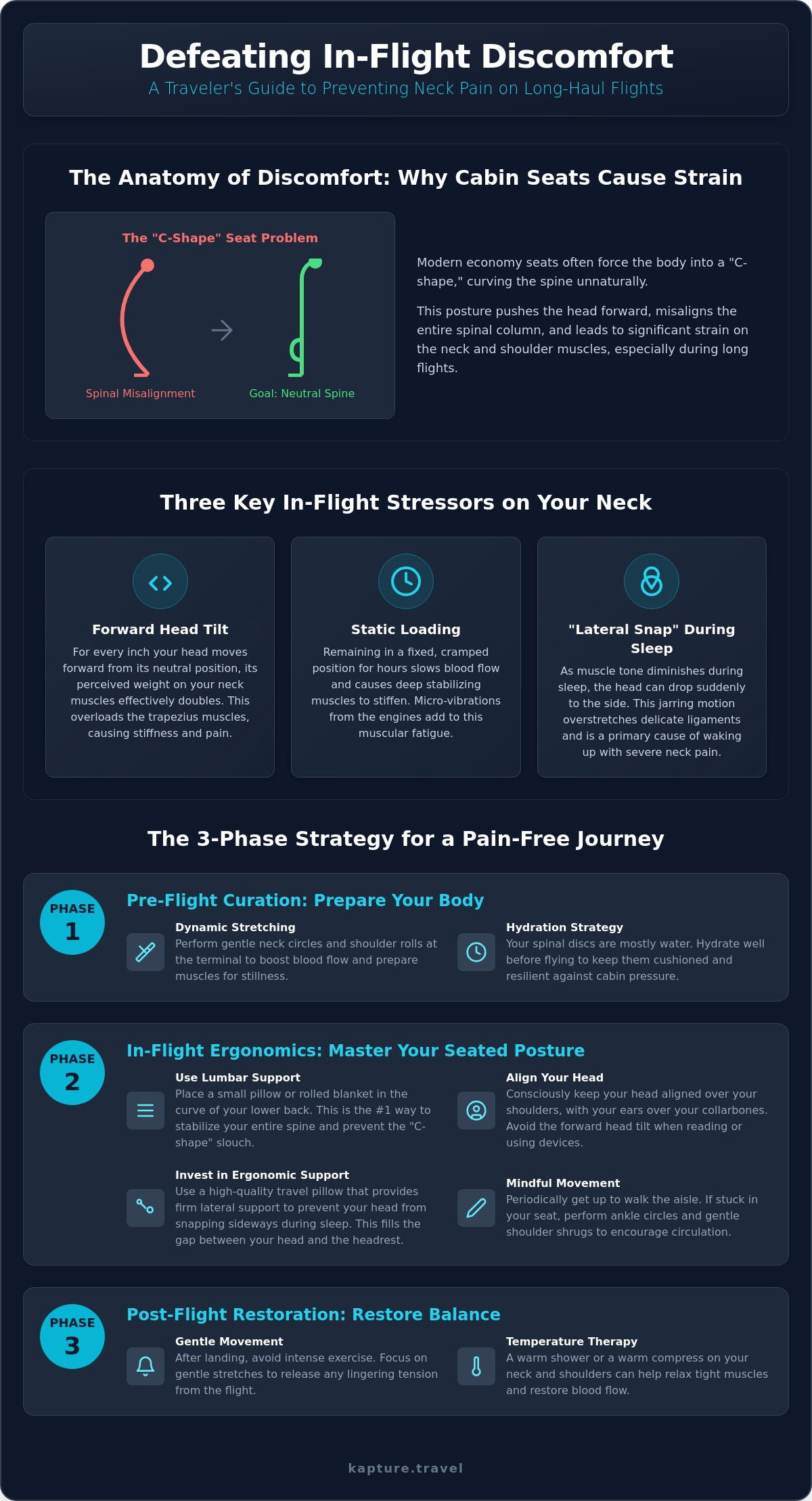
The modern aircraft cabin is a masterpiece of density, yet it often fails as a sanctuary for the human form. When we settle into an economy seat, we're immediately confronted by the "C-shape" curvature; a design choice that prioritizes safety and space over the natural alignment of the spine. This geometry forces the cervical spine into a state of unnatural flexion, pulling the head forward and away from its structural center. Understanding the ergonomics of the cabin is essential for any traveler seeking to maintain their physical poise during transit.
Beyond the seat's shape, the body must contend with static loading. This is the physiological toll of remaining in a fixed, cramped position for hours, where blood flow slows and muscles begin to stiffen in protest. Subtle micro-vibrations from the aircraft's engines further complicate this, causing the deep stabilizing muscles of the neck to work overtime. Learning how to prevent neck pain on plane journeys begins with recognizing these invisible forces that shape our physical experience in the sky. This awareness allows you to curate your environment with intention.
To better understand the mechanics of travel comfort, watch this helpful guide on maintaining mobility:
The Forward Head Tilt Phenomenon
Precision is everything in visual composition, and the same holds true for the body. For every inch your head tilts forward, the perceived weight on your neck muscles effectively doubles. This creates a relentless demand on the trapezius muscles as they struggle to stabilize the skull against the jolts of turbulence. You might first notice a faint tightness at the base of the skull or a subtle warmth in the shoulders. These are the early whispers of flight-induced tension, signals that the neutral alignment of your spine has been compromised by the cabin's geometry. Managing how to prevent neck pain on plane travel requires addressing this tilt before the descent begins.
The Gravity of Sleep in the Sky
The most vulnerable moments occur when we surrender to sleep. As you enter REM cycles, your muscle tone naturally diminishes, leaving the cervical spine without its usual internal support. This often leads to "lateral snap," that jarring sensation when the head drops sideways, overstretching delicate ligaments. Standard headrests, while functional for safety, rarely provide the lateral stabilization needed to keep the head centered. To truly master the art of the journey, you must find ways to fill the architectural gaps between the body and the seat, creating a private gallery of comfort amidst the clouds. Achieving a neutral spine is the ultimate goal, turning a space designed for density into a personal studio of rest.
Pre-Flight Curation: Preparing the Body for the Skies
The journey doesn't begin at the gate. It starts in the deliberate choices you make before the cabin door seals. To master how to prevent neck pain on plane journeys, one must treat the body like a finely tuned instrument. Think of hydration not just as a thirst-quencher, but as a vital lubricant for your internal architecture. The intervertebral discs in your cervical spine are largely composed of water; they require high levels of fluid to maintain their cushioning properties against the dry, pressurized environment of the sky. A well-hydrated spine is a resilient one, better equipped to handle the static loading of a long-haul flight.
In the terminal, the discerning traveler finds quiet corners for a physical prelude. Rather than static poses, focus on dynamic movement that encourages blood flow. Incorporating specific exercises to prevent neck pain, such as gentle neck circles and rhythmic shoulder rolls, prepares the muscles for the hours of stillness ahead. This is the moment to counter the "hunch" that inevitably comes from navigating security lines and carrying heavy carry-on bags. By warming up the trapezius and levator scapulae, you create a buffer against the tension of transit.
The Art of Departure Ritual
Before boarding, establish a sequence that grounds you. Perform a series of gentle chin tucks to activate the deep neck flexors, the muscles responsible for maintaining a noble posture. Opening the chest and drawing the shoulder blades together creates a wider, more stable base for the neck to rest upon. This ritual is a vital component of The Art of Departure: A Sophisticated Travel Preparation Checklist for 2026, ensuring you board with a sense of physical equilibrium and poise.
Curating Your In-Flight Sanctuary
Your choice of seat is your first piece of ergonomic architecture. While the aisle offers freedom, the window seat provides a structural anchor, a solid surface against which you can compose your rest. Before you even sit, visualize your setup. Think about where your support will go and how you will fill the gaps left by the seat's design. Choosing the right gear is paramount; a generic, flimsy pillow is perhaps the most common mistake made in travel preparation. Instead, consider the precision of a BioNTex™ Travel Neck Pillow Set, which offers the stability required to preserve your alignment throughout the flight.
Luggage logistics also play a silent role in your comfort. The sudden, awkward lift of a heavy bag into an overhead bin can micro-tear muscles already stressed by travel. Be mindful of your mechanics; use your legs and keep the weight close to your body to avoid setting the stage for a painful arrival. By understanding how to prevent neck pain on plane travel through pre-flight curation, you arrive ready to document your story with clarity and comfort.
The Ergonomics of the Cabin: Mastering the Seated Posture
The aircraft seat is a study in compromise, a rigid structure that rarely accounts for the elegant curves of the human spine. To master how to prevent neck pain on plane travel, you must first neutralize the headrest. Most seats feature a forward-protruding upper section that aggressively pushes the skull forward, forcing the cervical spine into a strained arc. By placing a specialized support into the void between your neck and the seat, you restore the natural silhouette of your posture. This simple act of curation transforms a source of tension into a foundation of rest, allowing you to exist within the space rather than fighting against it.
The secret to a serene neck often lies far below the shoulders, in the lumbar region. When the lower back slumps into the hollow of the seat, the entire spine cascades into a "C" curve, inevitably causing the head to jut forward. Supporting the small of your back with a rolled garment or a dedicated cushion stabilizes the pelvis and provides the structural integrity your neck requires. This foundation is essential for avoiding the hidden dangers of screen ergonomics. Looking down at a tablet or a low-mounted entertainment screen for hours creates a relentless pull on the posterior neck muscles. Position your devices at eye level whenever possible, ensuring your gaze remains horizontal and your chin stays parallel to the floor.
Step-by-Step Cabin Alignment
To begin your alignment, adjust the seat-back to a gentle recline of approximately 110 degrees. This angle distributes your upper body weight more evenly across the seat's surface, reducing the pressure on individual vertebrae. Ensure your feet are flat on the floor or a footrest; this stabilizes the pelvis and prevents the lower back from rounding. Finally, secure your BioNTex™ Travel Neck Pillow Set to fill the architectural gaps between your body and the chair. This ensures your chin remains elevated and your airway stays clear, allowing for a deeper, more restorative rest during transit.
In-Flight Rhythms and Movement
Stagnation is the enemy of comfort. Adopt a thirty-minute rhythm of movement to prevent muscle tension from setting like drying clay. Perform subtle shoulder retractions by drawing your blades together, a movement that resets the thoracic spine and opens the chest. Use the "Floating Head" visualization; imagine a silk string pulling the crown of your head toward the ceiling to decompress the spine. Complement this with gentle isometric holds, pressing the back of your head into your pillow for five seconds to engage the stabilizing muscles without moving the joint. These small, rhythmic adjustments preserve the soul of your journey and ensure you arrive with a sense of effortless poise.
The BioNTex™ Advantage: A New Era of Travel Wellness
The evolution of travel wellness has moved beyond simple utility. It now resides at the intersection of advanced materiality and artistic intent. While previous sections explored the mechanics of posture, the physical tools you choose are the final brushstrokes in your ergonomic composition. Standard travel pillows often fail because they lack the structural integrity to hold the head in a neutral position, collapsing under the weight of a long-haul journey. Understanding how to prevent neck pain on plane travel requires a shift toward gear that offers both high-density support and a refined sensory experience. It's about choosing an accessory that respects the anatomy of the journey.
The BioNTex™ Travel Neck Pillow Set represents this new era of precision. Its core is crafted from high-density memory foam that mirrors the unique contours of your cervical spine, providing a firm yet yielding foundation. This material choice is deliberate; it resists the "lateral snap" of sleep by offering consistent stabilization throughout the varying phases of flight. By filling the void between the neck and the cabin seat, it ensures your silhouette remains balanced and your spine stays aligned.
Protection Meets Perspective
In the shared environment of a cabin, wellness is a multi-dimensional concept. The BioNTex™ technology provides an invisible layer of protection through its antiviral coating, a verified innovation available since February 2026. This technical metaphor for safety allows the traveler to focus on the emotional resonance of the journey rather than the logistics of hygiene. The set approach, which includes a dedicated storage solution, ensures your sanctuary remains pristine and aligns with a sophisticated travel aesthetic. It's a commitment to sustainable sophistication, utilizing upcycled fabrics that resonate with the values of the modern, environmentally conscious explorer. This peace of mind is as essential to comfort as the physical support itself.
Curated Collections for the Individual
Style should never be sacrificed for substance. Artistic collaborations allow travelers to express their personality through limited editions like the Moomin Travel Pillow series, bringing a sense of nostalgia to the modern cabin. For those seeking a blend of high-end fashion and ergonomic function, the Kapture x MOGOLS collection offers a distinct visual narrative. These compact sets fit seamlessly into a curated travel wardrobe, proving that the tools for how to prevent neck pain on plane flights can be as elegant as the destinations they help you reach. They are designed for density and portability, ensuring your toolkit for wellness never feels like a burden.
Elevate your in-flight experience and protect your physical poise by securing your own BioNTex™ Travel Neck Pillow Set before your next departure.
Post-Flight Rituals: Restoring Balance After the Journey
The moment you step onto solid ground marks the beginning of a vital recalibration. While your focus has been on how to prevent neck pain on plane travel through ergonomic curation, the transition from the cabin to the destination requires its own set of rituals. The first hour on the ground is a sacred window for the body. Gentle walking is the most effective antidote to the static loading experienced during flight. It encourages blood flow to the spinal discs and allows the muscles to rediscover their natural rhythm after hours of confinement. This simple movement serves as a palette cleanser for the physical self, washing away the rigidity of transit.
Light and perspective play a significant role in this restoration. Seeking out natural sunlight immediately upon arrival does more than just reset your circadian rhythm; it signals the nervous system to release the protective tension held in the neck and shoulders. Think of it as adjusting the exposure on a photograph to reveal the true depth of the landscape. If lingering stiffness remains, choose your temperature therapy with intention. Heat is a sophisticated tool for soothing chronic stiffness by increasing tissue elasticity, while cold is better suited for calming any acute inflammation from an awkward sleep position. These choices ensure your physical silhouette remains as sharp as your artistic vision.
Restorative Movement Sequences
To fully erase the "C-shape" memory of the cabin, engage in a sequence of wall slides. By standing against a flat surface and slowly moving your arms upward while keeping your spine in contact with the wall, you recalibrate your posture and open the chest. Complement this with a gentle rotation of the cervical spine. Focus your gaze on a distant horizon; this visual anchor helps reset the tiny muscles of the eyes and neck that have been strained by close-up screens. Finally, practice deep diaphragmatic breathing. This releases the accessory neck muscles that often take over the work of breathing when we're hunched in a seat, allowing for a complete release of held tension.
Preserving the Memory, Not the Pain
The true success of knowing how to prevent neck pain on plane journeys is measured by your ability to immerse yourself in the destination's narrative the moment you arrive. Arriving without pain allows you to focus on the soul of a place, capturing its essence with a clear mind and a rested body. As you unpack, treat your gear with the same respect you give your camera or your journals. Transitioning your BioNTex™ pillow back into its storage set preserves its integrity for the next departure. For a deeper look at the tools that define the modern explorer, explore The Art of the Journey: A Guide to the Modern Travel Supplies Specialty Store in 2026. The most beautiful souvenir isn't an object, but a memory preserved through a lens of comfort and quiet elegance.
Reclaiming the Horizon: Your Path to Pain-Free Transit
The journey is more than a sequence of coordinates; it's a narrative that deserves to be experienced with absolute clarity. By understanding the architectural challenges of the cabin and mastering how to prevent neck pain on plane flights, you transform transit from a physical burden into a moment of mindful preparation. You've learned that the secret to a serene arrival lies in neutralizing seat geometry, embracing rhythmic movement, and selecting tools that mirror the elegance of your destination. Comfort isn't a luxury of the few, but a curated choice made by the discerning traveler who values the soul of the experience.
Every detail of your toolkit should reflect your values. With its innovative anti-viral technology and commitment to eco-friendly upcycled materials, the right gear provides both physical stability and emotional peace of mind. It's a blend of award-winning sophistication and practical resilience that ensures your focus remains on the beauty of the world outside the window. Discover the BioNTex™ Travel Neck Pillow Set for your next journey and redefine your perspective on the sky. Step off the aircraft not as a weary passenger, but as an inspired curator of your own story, ready for the next frame.
Frequently Asked Questions
Is it better to use a neck pillow in the front or the back of my neck?
Positioning your pillow toward the front or slightly to the side is often more effective than placing it at the back. Most cabin seats already push the head forward; adding a pillow behind the neck only exacerbates this tilt. By securing support under the chin or along the side, you prevent the jarring "lateral snap" during sleep and keep the cervical spine in a noble, neutral alignment.
Can I prevent neck pain if I'm stuck in a middle seat?
You can certainly find relief in a middle seat by focusing on internal stabilization rather than leaning on the aircraft's walls. The key to how to prevent neck pain on plane travel in this position is creating a firm lumbar foundation. Use a rolled garment to support your lower back, which naturally aligns the neck, and use a high-density memory foam pillow to keep your head centered without needing an external anchor.
How often should I move during a 10-hour flight to avoid stiffness?
Aim to introduce rhythmic movement every thirty to sixty minutes to prevent muscle tension from setting like drying clay. You don't always need to leave your seat; simple shoulder retractions and isometric neck holds can be performed while seated. These small, deliberate adjustments act as a physical reset, ensuring that the stillness of a long-haul journey doesn't become a permanent state of stiffness upon arrival.
Does the BioNTex™ technology lose its effectiveness after washing?
BioNTex™ technology is engineered for enduring quality and remains effective through repeated maintenance. The antiviral properties are integrated into the fabric's soul, ensuring that your layer of protection remains intact journey after journey. This meticulous craftsmanship allows you to wash your travel set without sacrificing the sophisticated hygiene that defines the modern wellness experience.
What is the best way to support my head if I don't have a travel pillow?
If you find yourself without a dedicated pillow, the best strategy is to use a thick scarf or a folded jacket to fill the architectural gaps. Focus on supporting the space between your shoulder and your jaw to prevent the head from tilting. This makeshift curation provides the necessary lateral stabilization to protect the delicate ligaments of the neck from the pull of gravity during rest.
Why does my neck hurt more after I wake up from a nap on a plane?
Your neck often hurts more after a nap because muscle tone diminishes during deep sleep, leaving your spine vulnerable to gravity. Without a structured support to hold your head in place, the cervical vertebrae can shift into extreme angles. This misalignment creates micro-strains in the ligaments, leading to that familiar, sharp stiffness that greets you upon waking in the cabin.
Are there specific stretches for neck pain that I can do without leaving my seat?
Several discrete stretches can be performed within the confines of your seat to maintain physical poise. Gentle chin tucks activate the deep neck flexors, while slow ear-to-shoulder tilts release the tension in the upper trapezius. These movements are essential for how to prevent neck pain on plane flights, allowing you to recalibrate your posture without disrupting the quiet atmosphere of the cabin.
How can I tell if my neck pain after a flight is serious enough to see a doctor?
While most travel stiffness fades within twenty-four hours, certain signals require professional perspective. If you experience persistent numbness in your arms, sharp radiating pain, or a significant loss of mobility that doesn't respond to gentle movement, it's wise to consult a specialist. These symptoms may indicate a deeper structural issue rather than the simple fatigue of a journey well-traveled.
