
The Art of the Minimalist Travel Packing Guide: Curating Your Journey in 2026

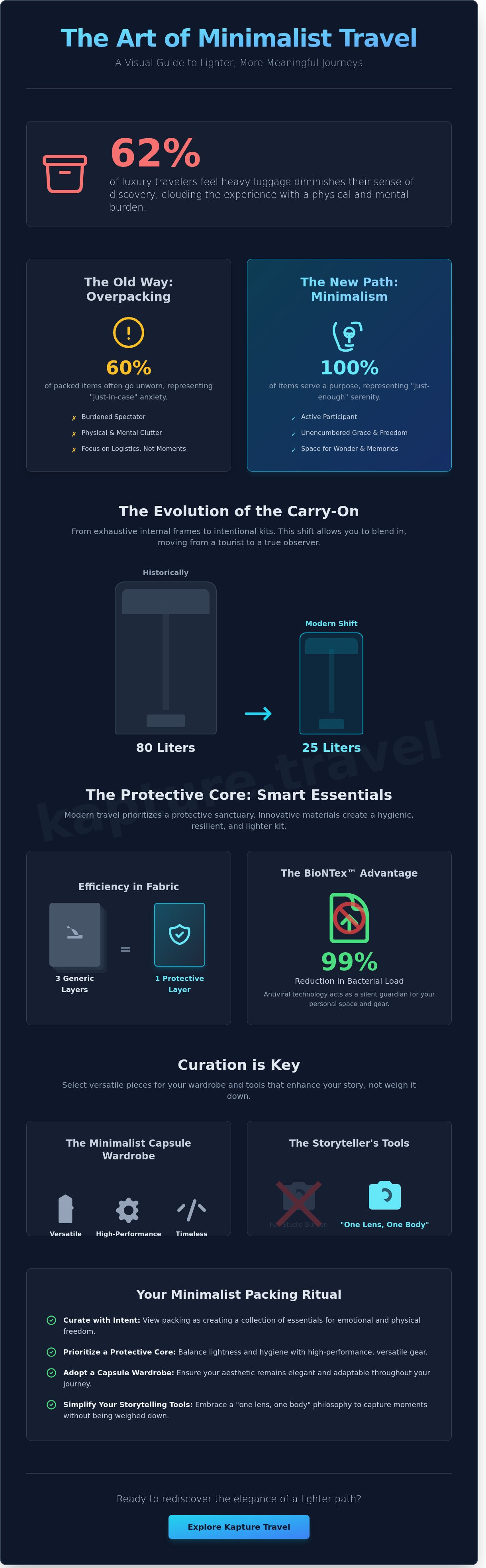
What if the true cost of your journey is measured in the pounds of luggage you drag across the sun-drenched paths of discovery? For many, the thrill of departure is shadowed by the physical burden of overpacking. In 2024, industry reports indicated that 62% of luxury travelers felt their heavy bags actively diminished their sense of discovery. This minimalist travel packing guide addresses that weight, which often clouds the lens of our experience and pulls focus from the beauty of the present moment.
By mastering this sophisticated art form, you'll rediscover the emotional resonance and quiet elegance of a lighter path. We'll show you how to curate a bespoke wardrobe that prioritizes essence and effortless movement through any landscape, from airport lounges to remote vistas. We'll also explore how protective technology provides a sanctuary for your gear, ensuring hygiene and peace of mind. This guide offers a new vantage point where every item serves the story of your trip, allowing you to capture the world with clarity and grace.
Key Takeaways
- Learn to view packing as a deliberate curation of essentials that grants you the emotional freedom to move through the world with unencumbered grace.
- Identify the core essentials that balance protection and lightness, prioritizing high-performance tools for a more refined and hygienic transit experience.
- Curate a timeless capsule wardrobe using this minimalist travel packing guide to ensure your aesthetic remains elegant and versatile throughout your entire journey.
- Adopt a "one lens, one body" philosophy to capture the essence of your surroundings without the physical burden of a professional studio.
- Master the ritual of the final pack to transition seamlessly from the logistics of planning to the immersive poetry of your departure.
The Philosophy of the Frame: Why Minimalist Packing Transcends Logistics
To travel is to compose a scene. Every object you carry dictates the light and shadow of your journey, shaping how you interact with the world. Minimalist packing isn't a practice of deprivation; it's the deliberate curation of essentials to achieve emotional and physical freedom. It transforms your perspective, shifting your focus from the weight on your shoulders to the clarity of the horizon ahead. By understanding The Philosophy of Minimalism, travelers learn that less isn't a void. It's a purposeful space that allows the essence of a destination to breathe.
This minimalist travel packing guide views every item as a character in a cinematic narrative. You trade the "just-in-case" anxiety, which often results in 60% of packed items remaining unworn, for a "just-enough" serenity. This isn't just about logistics. It's about moving through the world with unencumbered grace. When you're light, your vantage point changes. You're no longer a spectator burdened by gear; you're a participant in the local rhythm.
To better understand this concept, watch this helpful video:
Redefining the Carry-On as a Curated Gallery
Your travel bag is a bespoke collection that reflects your aesthetic sensibility. Historically, travelers lugged 80-liter internal frame packs that dictated their movement and exhausted their energy. The modern shift toward a 25-liter intentional kit marks a transition from tourist to observer. This reduction allows for more authentic local encounters. You blend into a crowded Roman piazza or a narrow Kyoto alleyway without the physical footprint of a traditional traveler. It's a commitment to sustainability and style, ensuring your presence is felt through your spirit rather than your luggage size.
The Emotional Resonance of Ethereal Movement
Physical weight translates directly to mental clutter. Reducing your kit often doubles your capacity for wonder. You create space for new memories by removing the burden of old possessions. This ethereal movement allows you to find the timeless essence of a place. You aren't managing gear; you're capturing moments. When you strip away the unnecessary, you're left with a kit that serves your journey, not the other way around. It's a psychological liberation that turns a simple trip into a transformative story.
The Protective Core: Hygiene and Versatility in 2026
Modern travel is a composition of light and shadow, where the weight of one's luggage shouldn't obscure the clarity of the experience. By 2026, the philosophy behind a minimalist travel packing guide has shifted from merely reducing ounces to curating a protective sanctuary. Travelers now seek a bespoke balance between mobility and a high standard of hygiene. This evolution places three pillars at the center of every kit: a versatile vessel, ergonomic support, and intelligent storage. It's a pursuit of the ethereal, where the invisible shield of technology allows the traveler to focus on the frame of the landscape rather than the maintenance of their gear.
The essence of this new standard lies in fabric innovation. When every item in your bag must earn its place, materials that actively repel pathogens become indispensable. This isn't just about cleanliness; it's about the freedom to move through crowded terminals and intimate local cafes without the burden of extra layers. By selecting items with a protective soul, you reduce the necessity for frequent laundering, which often ages quality garments prematurely. A kit built on these principles isn't just lighter; it's more resilient.
The BioNTex™ Advantage: A New Standard for Travel
Integrating BioNTex™ technology into your kit transforms the narrative of your journey. This antiviral innovation doesn't just sit on the surface; it becomes a silent guardian of your personal space. In a 2024 study, similar antimicrobial treatments showed a 99% reduction in bacterial load on textiles, proving that a single protective layer can replace three generic alternatives. This approach fosters a more sustainable journey, as fewer washes extend the life of your curated wardrobe. It's a way to capture the essence of slow travel, where quality outweighs quantity in every frame.
The Multi-Functional Anchor: Choosing Your Primary Vessel
Your bag is the frame through which your entire journey is viewed. Evaluating a versatile option like the BioNTex™ Foldable Travel Bag reveals a mastery of transformative capacity. In 2026, the most sophisticated travelers prioritize upcycled and sustainable materials that reflect their personal values. These vessels are designed to expand or contract based on the narrative of the day. A well-chosen anchor piece ensures that your minimalist travel packing guide remains practical across varying climates. To find these intentional pieces, visit a specialty store locator to ensure your selections meet the highest standards of craftsmanship.
- Protection: Focus on antiviral fabrics to minimize laundry cycles.
- Sustainability: Prioritize upcycled materials that age with grace.
- Versatility: Choose vessels that adapt to your specific vantage point.
Before you depart, consider how a protective travel pillow can provide both comfort and peace of mind on long-haul flights.
Curating Your Visual Narrative: The Minimalist Capsule Wardrobe
The wardrobe you carry defines the boundary between the traveler and the landscape. It's a curated selection of textures that must perform under the scrutiny of a high-resolution lens. Every piece should be a timeless silhouette, avoiding the fleeting noise of fast-fashion trends that age poorly in a digital archive. This minimalist travel packing guide suggests focusing on structural integrity. A well-tailored linen shirt or a structured blazer creates a silhouette that remains elegant whether you're at a street-side cafe in Paris or a mountain overlook in Bhutan.
The "rule of three" remains the gold standard for weight efficiency; wear one, wash one, and keep one spare. Adopting this logic can reduce your luggage volume by 45% on average compared to traditional packing methods. Color palettes should be monochromatic or tonal. When every item shares a common hue, you eliminate the friction of choice. Every combination becomes a harmonious frame, allowing the traveler to blend into the environment with quiet sophistication.
Texture and Light: Selecting Fabrics for Every Climate
Light interacts differently with various textiles. Merino wool is a favorite for its ability to stay fresh for up to 72 hours of continuous wear. It captures light with a soft matte finish that looks exceptional in photographs. For those seeking advanced protection, BioNTex™-treated cotton provides a technical edge. This material reduces 99.9% of bacteria; it ensures your garments remain pristine through long transit days. Puffy textures, like a quilted vest, add visual depth and shadows to your outfit without adding significant weight to your carry-on. These textures are essential for capturing "ethereal" lighting conditions found during the blue hour in high-altitude regions.
The Art of Layering: Building a Bespoke Travel Uniform
Layering is the mechanism through which you adapt your narrative to changing altitudes. A bespoke travel uniform relies on pieces that stack seamlessly. Foldable outerwear is the anchor here. A high-quality shell that weighs less than 300 grams can protect against a sudden coastal mist while maintaining a sharp profile. This minimalist travel packing guide prioritizes the singular over the plural. One high-quality silk scarf or a handcrafted leather belt provides more character than five mediocre accessories. It's about the essence of the object. Choose items that possess a quiet elegance; they should feel like an extension of your own perspective and artistic legacy.
The Tools of the Storyteller: Tech and Photography
Minimalism is an edit. It's the conscious choice to leave the heavy glass and the tangled wires at home, opting instead for a singular, intimate connection with the environment. To travel light is to see clearly. When you aren't burdened by the weight of a professional studio, the world opens up. You move faster. You blend into the shadows of a Parisian cafe or the golden light of a Tuscan field. This minimalist travel packing guide focuses on the essential tools that allow you to capture the soul of a place without sacrificing your mobility.
Capturing the Essence: Essential Photography Gear
By 2026, the photography landscape has shifted toward high-end compact cameras that prioritize the artistic vantage over raw megapixels. The "one lens, one body" philosophy is no longer a sacrifice; it's a creative liberation. A fixed 35mm or 28mm lens forces you to engage with your subject. You don't zoom with a dial; you zoom with your feet. This movement creates a deeper narrative in every frame.
Protecting these bespoke instruments requires a thoughtful approach within a soft-sided bag. Heavy, padded camera cubes are often too bulky for the refined traveler. Instead, use items that serve dual purposes to save space. The Crossbody Puffy Bag serves as a discreet, cushioned camera insert. It protects the sensor and glass from the rigors of transit while remaining light enough to carry during a long day of exploration. It's a sophisticated solution for the artist who values both form and function.
- Opt for fixed-lens cameras with large sensors for ethereal low-light performance.
- Use lightweight, multi-purpose wraps instead of dedicated rigid cases.
- Carry only two high-speed SD cards; one in the camera, one in a secure pocket.
The Digital Zenith: Streamlining Electronics
The tablet has evolved into a cinematic editing suite. With the processing power of 2026-era chips, you can edit 4K RAW files with a tactile intimacy that a laptop cannot match. This allows you to stay present. You can curate your day's journey while sitting on a balcony, rather than being hunched over a desk. Maintaining a clean digital footprint is equally vital. Offload your captures to encrypted cloud storage nightly, ensuring your narrative is safe even if your hardware stays on the road.
Streamline your creative process and protect your vision by choosing gear that moves as fast as you do. Discover the art of protected travel gear.
The Final Curation: Mastering the Art of Departure
The transition from a conceptual itinerary to the physical suitcase marks a shift in energy. It's no longer about what you might need; it's about what you cannot live without. This final curation is a ritual of subtraction. It requires a discerning eye to ensure every object in your bag serves the narrative of your journey. By following a refined minimalist travel packing guide, you transform the act of packing from a chore into a deliberate preparation for discovery. This is the moment where your aesthetic vision meets the practical constraints of the road.
The Packing Ritual: A Step-by-Step Guide to the Perfect Fold
Efficiency in a small carry-on relies on how you treat the fabric. The "bundle" method involves wrapping garments around a central core to prevent deep creases; however, the "roll" method remains the superior choice for maximizing volume, often saving 25% more space in a bespoke leather weekend bag. Use shoe cases to isolate the grit of the street from your silk layers. These cases act as internal boundaries, compartmentalizing your narrative so that every item has a dedicated vantage point. Before closing the lid, perform a final 10-minute audit. This "final frame" check ensures that if an item doesn't contribute to your comfort or your aesthetic purpose, it hasn't earned its place in your story.
Embarking with Purpose: The Kapture Experience
The transit phase is often overlooked, yet it's the bridge between your old perspective and your new destination. To maintain a sense of quiet elegance during a long-haul flight, the BioNTex™ Travel Neck Pillow Set provides a sanctuary of comfort. It's more than an accessory; it's a tool for the modern minimalist who values wellness as much as style. This set ensures you arrive at your vantage point refreshed and ready to capture the essence of your surroundings. Utilizing a sophisticated preparation checklist ensures a seamless exit, allowing you to leave the chaos of the everyday behind.
A conscious journey concludes with a commitment to the earth you're exploring. Emphasizing sustainability is the final, most vital step in any minimalist travel packing guide. By selecting high-quality gear designed to last for a decade or more, you reduce the need for disposable alternatives. When you travel with fewer, better things, the journey itself becomes the destination. You aren't just moving through space; you're curating a timeless artistic legacy. Every trip is a chance to frame the world through a lens of sophistication, leaving behind nothing but the echoes of a well-told story.
Stepping Into the Frame of 2026
Packing for the 2026 season isn't merely a task of logistics. It's an act of curation. By adopting a minimalist travel packing guide, you reclaim the mental space needed to truly inhabit your surroundings. You've seen how a versatile capsule wardrobe creates a seamless visual narrative, and how prioritizing hygiene through technical fabrics ensures your focus remains on the vantage point ahead. The goal is a light footprint and a deep impression.
True luxury requires a commitment to the future of our planet. Our designs feature innovative BioNTex™ antiviral technology for peace of mind during every transit. We craft every piece from sustainable, upcycled fabrics to support the conscious explorer's ethos. These garments provide the technical precision required for modern travel while maintaining a sophisticated, cinematic silhouette. Capture the essence of your next journey with our BioNTex™ Travel Collection.
The world is ready for your unique lens. Step out with confidence and let your next story begin.
Frequently Asked Questions
What is the "one-bag" rule in minimalist travel?
The "one-bag" rule dictates that all your belongings must fit within a single carry-on bag, typically adhering to the IATA standard dimensions of 55 x 35 x 20 cm. This constraint simplifies your narrative, allowing you to move through transit hubs with the grace of a seasoned curator. By limiting yourself to 7 to 10 kilograms of total weight, you eliminate the friction of checked luggage and focus on the essence of your destination.
How many days of clothes should I pack for a minimalist trip?
You should pack exactly 5 to 7 days of clothing, regardless of your trip's duration. This minimalist travel packing guide suggests utilizing a modular wardrobe where every piece serves a dual purpose. For a 14-day journey, this strategy reduces your volume by 50 percent compared to traditional packing. You'll rely on high-quality fabrics that maintain their shape and aesthetic through multiple wears.
Can I really travel for a month with only a carry-on?
Traveling for 30 days with only a carry-on is entirely possible when you prioritize technical layers and laundry cycles. You'll need to select 3 pairs of shoes maximum and a color palette that allows for 10 unique outfit combinations. This approach transforms your luggage into a bespoke collection of essentials. It ensures your focus remains on the visual narrative of the trip rather than the weight on your shoulders.
What are the best fabrics for a minimalist travel wardrobe in 2026?
The best fabrics for 2026 are merino wool and recycled synthetic blends that offer 4-way stretch and moisture management. Merino wool remains the gold standard, as it naturally resists odors for up to 5 consecutive days of wear. These textiles provide a timeless silhouette while performing in varied climates. They allow you to capture the perfect frame without the distraction of wrinkled or heavy clothing.
Is minimalist packing possible for cold weather destinations?
Minimalist packing is highly effective for cold weather when you utilize a 3-layer thermal system. You'll pack a lightweight down jacket with an 800-fill power rating that compresses into a small pouch. By wearing your heaviest coat and boots during transit, you save 30 percent of your internal bag space. This method preserves the quiet elegance of your style even in the harshest landscapes.
How does BioNTex™ technology help with minimalist packing?
BioNTex™ technology enhances your minimalist travel packing guide by providing a long-lasting antiviral and antibacterial shield on fabric surfaces. This treatment reduces the need for laundering by 60 percent, keeping your garments fresh during long stretches of travel. It acts as an invisible layer of protection. You can carry fewer items because each piece stays clean and odorless for significantly longer durations.
What should I leave behind to achieve a minimalist packing list?
You should leave behind all "just in case" items and more than two pairs of heavy denim jeans. Statistics show that 80 percent of travelers don't use the extra items they pack for hypothetical scenarios. Ditch the full-sized toiletries and heavy hardcover books in favor of digital alternatives and solid concentrates. This creates a sense of movement and depth in your bag, leaving room for authentic local finds.
How do I choose the right minimalist travel backpack?
Choose a backpack with a capacity between 28 and 40 liters that weighs less than 1.5 kilograms when empty. Look for a harness system that distributes weight to your hips, reducing shoulder strain by 40 percent during long walks. The bag should serve as your mobile vantage point, organized with internal compartments that frame your gear perfectly. Select a weather-resistant exterior to protect your camera and essentials.
