
The Art of the High-Altitude Slumber: How to Sleep on a Plane in 2026
What if the low hum of a jet engine wasn't a barrier to rest, but the opening note of a restorative ritual? Achieving deep sleep at thirty thousand feet is not a matter of chance, but a deliberate act of curation. To master how to sleep on a plane, you must minimize sensory input and stabilize your cervical alignment. By securing a window seat for a fixed headrest, using noise-canceling tools, and utilizing firm EPP biodegradable cushioning, you create the physical conditions necessary for the brain to transition into restorative REM cycles while seated upright.
We understand that the modern cabin often feels like a theater of sensory assault, where physical discomfort and hygiene anxiety prevent true surrender. This guide will show you how to curate a private sanctuary through the intersection of material science and sensory control. We'll explore the biological architecture of rest, the ergonomics of durable support, and the peace of mind provided by BioNTex™ antiviral technology, ensuring you arrive at your destination with the clarity to appreciate every detail of your new surroundings.
Key Takeaways
- Learn how to sleep on a plane by mastering the window seat advantage, providing a stable fixed point for head rest away from high-traffic cabin aisles.
- Discover the ergonomic benefits of EPP biodegradable cushioning, which offers lightweight support and shape retention without the heat traps of traditional foam.
- Achieve deeper relaxation by addressing the hidden obstacle of cabin hygiene with BioNTex™ technology, providing 99% germ protection for your sleep gear.
- Curate a personal sanctuary through sensory control, strategically selecting seat locations that minimize the impact of fluctuating light and galley noise.
- Establish a repeatable high-altitude sleep ritual that prioritizes durable, luxury aesthetics and advanced material science for a refreshed arrival.
The Biological Architecture of In-Flight Rest
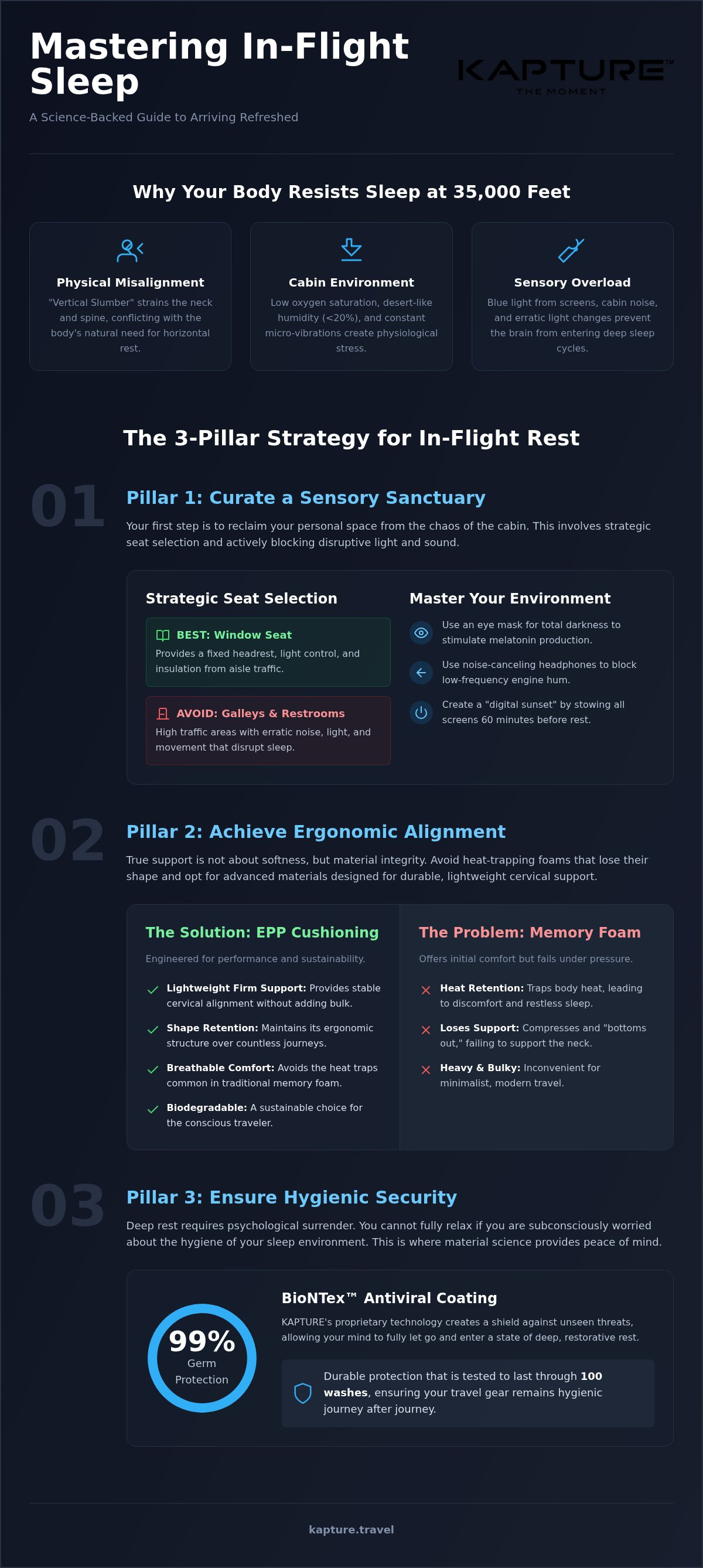
To master how to sleep on a plane, you must address three distinct biological hurdles: sensory overload, physical misalignment, and the subtle hum of hygiene anxiety. Achieving deep, restorative rest requires a curated environment that mimics the stillness of a private sanctuary. By combining sensory blockers with lightweight EPP biodegradable cushioning for cervical alignment and BioNTex™ antiviral protection to soothe the mind, you create a physiological signal that tells your brain it's safe to enter REM cycles. It's about transforming a public seat into a personal cocoon.
The "Vertical Slumber" is a direct conflict with human evolution. Our bodies are designed for horizontal rest. When we sit upright, gravity becomes a persistent force that pulls the head forward and strains the delicate structures of the neck. This physical tension is compounded by the cabin's pressurized atmosphere. Most aircraft are pressurized to an altitude of 6,000 to 8,000 feet. This slightly lowers oxygen saturation in the blood, often manifesting as a restless, light sleep that leaves you feeling unanchored upon arrival.
Why the Body Resists Sleep at 35,000 Feet
Long-haul journeys often lead to a circadian rhythm sleep disorder. Your internal clock, once a steady metronome, begins to drift. This biological friction is exacerbated by the desert-like dryness of the air. With humidity levels often dipping below 20%, the body enters a state of mild physiological stress. Even when you find a moment of stillness, the constant micro-movements and low-frequency vibrations of the engines act as a sensory "noise." These interruptions prevent the brain from descending into the deep, restorative stages of the sleep cycle.
The Three Pillars of the Sleep Strategy
Overcoming these biological barriers requires a deliberate, three-part architecture of comfort:
- Sensory Control: You must curate a visual and auditory void. Minimalist light-blocking techniques signal the brain to begin its nocturnal transition.
- Ergonomic Alignment: True support comes from material integrity. EPP biodegradable cushioning provides firm, lightweight support that retains its shape, avoiding the heat-retention issues common in other materials.
- Hygienic Security: Deep sleep requires psychological surrender. Knowing your immediate environment is protected by BioNTex™ technology, which offers 99% germ protection, provides the peace of mind necessary for true relaxation.
Curating Your Sanctuary: Sensory Control and Seat Strategy
If the aircraft cabin is a theater of movement and light, mastering how to sleep on a plane requires a deliberate approach to cabin geography. Your seat isn't just a coordinate on a boarding pass; it's the frame for your rest. Achieving deep slumber at altitude is an exercise in curation, where you intentionally filter out the chaotic stimuli of a shared public space to create a private, internal sanctuary. This process begins long before the cabin lights dim, starting with the strategic selection of your environment.
The Strategic Seat Selection Guide
The window seat is the undisputed canvas for a successful sleep setup. It provides a structural anchor, offering a fixed point where you can rest your head without the interruption of neighbors moving past or the accidental brush of a service trolley. This physical boundary allows you to lean into your support system, whether you're using the bulkhead or the fuselage as a steadying surface. When you're anchored against the window, you control the light, ensuring that a sudden sunrise doesn't shatter your carefully constructed sleep cycle.
Proximity to high-traffic zones is the most common deterrent to rest. Rows near the galleys or restrooms are subject to erratic light cycles and the rhythmic, percussive sound of doors and latches. These sensory spikes prevent the brain from settling into a steady rhythm. Instead, aim for the mid-cabin sections, away from the hum of the engines and the bustle of crew preparations. This positioning provides a more consistent auditory and visual landscape, allowing your mind to drift with fewer interruptions.
Mastering the Sensory Environment
Creating a "digital sunset" is a critical step in signaling the brain to produce melatonin. The sharp blue light from seatback screens acts as a biological alarm, keeping the mind in a state of high-altitude alertness. By stowing devices sixty minutes before your intended rest, you allow your nervous system to decelerate. This transition is further enhanced by high-quality eye masks that provide total darkness, creating the visual void necessary for the brain to begin its nocturnal descent.
- Auditory Isolation: Noise-canceling technology is a requirement, not a luxury. It replaces the abrasive roar of the turbines with a curated silence or a steady, ambient soundscape.
- Thermal Layering: Cabin temperatures fluctuate with cinematic unpredictability. Using breathable layers allows you to adjust your micro-climate without waking, maintaining the steady core temperature required for deep sleep.
- Visual Closure: A simple eye mask does more than block light; it serves as a psychological boundary, telling the world that your sanctuary is closed for the duration of the flight.
The challenge of how to sleep on a plane is often won or lost by the quality of the environment you build around yourself. To further refine your in-flight experience, consider exploring the nuances of travel wellness and how intentional rituals can transform your next journey.
The Ergonomics of Support: Beyond the Memory Foam Myth
The pursuit of how to sleep on a plane often leads travelers to the seductive, sinking sensation of foam. However, this softness is a deceptive luxury. Traditional polymers are dense and trap body heat; they create a localized warmth that disrupts the body's natural cooling cycle during rest. As the hours pass, foam inevitably yields to pressure, losing its structural integrity and leaving the cervical spine to fend for itself. Achieving deep rest requires a shift in perspective, moving away from temporary softness toward enduring, architectural support.
The Physics of Enduring Support
True support requires a material that understands the physics of endurance. Lightweight EPP biodegradable cushioning offers a high-density structure that resists compression. It provides a firm foundation that remains unchanged from the first hour of flight to the tenth. Unlike inflatable options that offer a bouncy, inconsistent pressure, EPP retains its shape; it cradles the neck with a deliberate, steady precision that mimics a custom-fit sanctuary. This material science is the key to maintaining the "Vertical Slumber" without the physical cost of a journey poorly supported.
| Feature | EPP Biodegradable Cushioning | Memory Foam | Inflatable Pillows |
|---|---|---|---|
| Support Integrity | High; maintains shape indefinitely | Low; collapses under warmth | Unreliable; air shifts with weight |
| Thermal Comfort | Breathable; remains cool | Dense; traps body heat | Neutral; non-breathable surface |
| Durability | Long-lasting and resilient | Degrades with repeated use | Prone to leaks and punctures |
| Sustainability | Eco-friendly and biodegradable | Synthetic and non-recyclable | Plastic-based and disposable |
Cervical Alignment and the 360-Degree Cradle
Achieving deep rest requires more than just a place to lean. It requires the elimination of the "head bob," that jarring physical interruption when neck muscles finally surrender. A 360-degree support system ensures that whether you lean into the window or rest forward, your alignment remains neutral. This stability is the cornerstone of the BioNTex™ Travel Neck Pillow Set. It provides a tactile, sophisticated experience that prioritizes physical well-being over temporary softness, ensuring you wake up with a sense of clarity rather than a lingering ache.
- Structural Persistence: The EPP material does not compress over time, maintaining the same elevation for your head throughout the journey.
- Sustainable Craftsmanship: The core is biodegradable, aligning your personal comfort with a respect for the world's landscapes.
- Featherweight Design: Advanced material science ensures that professional-grade support doesn't add unnecessary bulk to your carry-on narrative.
The Hygiene Shield: Peace of Mind as a Sleep Aid
Deep rest is an act of psychological surrender. In the intimate confines of a public cabin, this surrender is often obstructed by a primal, often unconscious, awareness of our shared environment. When you consider how to sleep on a plane, you must account for the mental weight of high-touch surfaces and the invisible landscape of a transit space. This "germ-consciousness" acts as a persistent sensory anchor, keeping the mind in a state of low-level vigilance that prevents the descent into truly restorative REM cycles. To sleep deeply, one must first feel protected.
The reality of aircraft hygiene is a study in high-frequency contact. From the seatback latch to the headrest, every surface tells a story of previous journeys. By creating a sterile sanctuary within your immediate seating area, you provide your nervous system with the safety signals it requires to disengage from its surroundings. It is the transition from a public coordinate to a private, fortified cocoon.
Antiviral Technology: The BioNTex™ Innovation
The foundation of this sanctuary is built on material science. Proprietary BioNTex™ technology provides a sophisticated shield, offering 99% germ protection that remains effective through 100 washes. This is not a temporary treatment but a lasting travel legacy, designed for the seasoned traveler who values enduring quality. By utilizing antiviral fabrics, you significantly reduce the "traveler's burden"-that lingering fatigue and post-flight vulnerability that often follows long-haul exposure. It allows you to focus on the cinematic beauty of your arrival rather than the biological cost of the transit.
The Ritual of the Clean Journey
Incorporating hygiene into your pre-sleep cabin routine transforms a logistical necessity into a comforting ritual. There is a profound sensory comfort in the feeling of clean, protected fabrics against the skin. It serves as a tactile narrative of care and meticulous craftsmanship. As you settle into your seat, the presence of these advanced materials signals the beginning of your rest period, distancing you from the recycled air and shared surfaces of the aircraft. For those seeking a deeper technical understanding of this protective layer, you can explore the science behind BioNTex™ Technology.
This intersection of hygiene and tranquility is the final piece of the high-altitude slumber puzzle. When your environment is secure, your mind is free to wander into sleep. To begin curating your own sterile sanctuary for your next journey, explore the BioNTex™ Travel Neck Pillow Set and discover the peace of mind that comes with professional-grade protection.
The Kapture Travel Solution: Elevating Your Journey
Mastering how to sleep on a plane is the culmination of a meticulously planned ritual. It is the moment where an understanding of human biology meets the tangible, high-performance tools of modern comfort. The "Art of Departure" involves more than just arriving at the gate; it is about preparing your personal environment for a seamless transition into rest, which for many travelers includes ensuring their pets are in the premium care of Kitnap Cat Hotel. This ritual is elevated by gear from Kapture Travel that reflects a commitment to both material science and a refined, cinematic aesthetic. When you choose tools that respect the body's need for alignment and the mind's need for security, the transit becomes as significant as the destination itself.
The BioNTex™ Travel Neck Pillow Set
The 旅行頸枕套裝 by Kapture Travel is the centerpiece of this curated sanctuary. It eschews the heat-retaining myths of traditional materials in favor of lightweight EPP biodegradable cushioning. This core provides the firm, enduring support needed for long-haul cervical alignment while remaining exceptionally light in your carry-on. Wrapped in upcycled fabrics, the set features BioNTex™ antiviral coating technology, providing 99% germ protection that lasts through 100 washes. It is a tool designed for the seasoned traveler who views every journey as a visual narrative to be preserved, offering a curated aesthetic that complements a sophisticated travel wardrobe.
Sustainability is the new hallmark of luxury. By choosing materials like upcycled fabrics and a biodegradable core, you align your personal comfort with a broader respect for the environments you explore. This isn't just about a single flight; it is about a lasting travel legacy. The durability of the EPP core ensures that your support system won't collapse after a few uses, maintaining its shape and integrity for years of exploration. It allows you to solve the puzzle of how to sleep on a plane with grace, consistency, and a clear conscience.
A Sophisticated Conclusion to the Journey
The shift from "surviving" a flight to "curating" your experience has a profound impact on your arrival. When you step off the aircraft feeling refreshed and protected, you possess the clarity to engage with the soul of a new place immediately. You are no longer recovering from the transit; you are already immersed in the discovery. To help plan your next international excursion, click here for OTRAVELGUIDE’s travel and visa insights. Before your next departure, consider this final checklist for a rested arrival:
- Secure a window seat: Establish your fixed point for head rest and light control.
- Initiate a digital sunset: Signal your brain to rest one hour before sleeping.
- Deploy the BioNTex™ set: Ensure 360-degree ergonomic support and antiviral security.
- Layer for thermal control: Use breathable, upcycled apparel to maintain a steady core temperature.
The world is waiting to be seen through a lens of wonder and quiet elegance. By mastering the art of the high-altitude slumber, you ensure that you never miss a moment of the story. For the discerning explorer, the journey is not a barrier to be overcome, but a canvas for intentional rest. Kapture Travel invites you to begin your next chapter with the confidence that only true, scientifically backed comfort can provide.
Arriving with Clarity and Grace
Mastering how to sleep on a plane is more than a simple logistical achievement. It's an intentional act of curation that honors the transition between worlds. By moving beyond the heat-trapping myths of foam and embracing the structural integrity of EPP biodegradable cushioning, you provide your body with the enduring support it deserves. This isn't just about a single flight; it's about establishing a repeatable ritual that preserves your energy for the discoveries that lie ahead.
True luxury in 2026 is defined by the intersection of sophisticated design and advanced protection. With 99% BioNTex™ antiviral protection that remains effective through 100 washes, your seating area becomes a fortified sanctuary of peace. You shouldn't have to compromise your health for your wanderlust. When you prioritize sensory control and material science, the journey itself becomes a restorative part of the narrative.
Explore the Kapture BioNTex™ Travel Neck Pillow Set to elevate your next departure. The world is waiting to be documented through rested eyes. Arrive ready to capture every moment.
Frequently Asked Questions
Is it better to sleep on a plane or stay awake to fight jet lag?
It's generally better to sleep if your arrival time coincides with the morning or afternoon at your destination. Aligning your rest with the local time zone of your arrival helps reset your internal clock more effectively. If you're wondering how to sleep on a plane to maximize recovery, focus on quality over quantity. Even a few hours of deep, supported rest can significantly reduce the physiological stress of crossing time zones.
What is the best seat on a plane for sleeping in economy?
The window seat remains the premier choice for rest because it provides a stable, fixed point for head support. This position allows you to lean against the fuselage, creating a consistent anchor for your posture. Avoid the rows near galleys or restrooms where light fluctuations and high-traffic noise are most frequent. A mid-cabin window seat offers the most cinematic stillness available in a shared cabin environment.
Do travel pillows actually work for long-haul flights?
High-quality travel pillows are essential tools for long-haul journeys when they provide genuine cervical alignment. The efficacy depends entirely on material integrity. While soft alternatives often collapse, a set featuring EPP biodegradable cushioning maintains its shape for the duration of the flight. This consistent support prevents the sudden head bob that interrupts deep sleep cycles, ensuring you arrive feeling physically restored rather than strained by the journey.
How can I protect myself from germs while sleeping on a plane?
Protecting yourself requires a physical and psychological shield against high-touch surfaces. Utilizing gear treated with BioNTex™ antiviral coating technology provides a proprietary layer of 99% germ protection. This creates a sterile sanctuary for your face and neck, allowing you to surrender to rest without the lingering anxiety of cabin hygiene. It's a sophisticated way to maintain wellness while navigating the shared spaces of international transit.
Why is EPP cushioning better than memory foam for travel?
EPP biodegradable cushioning is superior because it offers exceptional shape retention without the heat-trapping properties of foam. Unlike traditional materials that lose their density and collapse over time, EPP remains firm and supportive for hours. It's also remarkably lightweight and sustainable. This material science ensures your neck stays cool and correctly aligned, avoiding the physical fatigue often caused by inferior, sinking alternatives that fail during long flights.
Can you wash a travel pillow with BioNTex™ coating?
Yes, the BioNTex™ coating is designed for enduring quality and can withstand 100 washes while maintaining its 99% germ protection. This longevity ensures your travel legacy remains hygienic and sophisticated over years of exploration. The ability to keep your sleep gear pristine without degrading its protective properties is a hallmark of premium travel wellness. It allows for a repeatable ritual of cleanliness for every new journey.
What should I wear to sleep comfortably on a plane?
Choose breathable, natural, or upcycled fabrics that allow for effortless thermal regulation. Cabin temperatures are famously unpredictable, so layering is the most effective strategy for maintaining a steady core temperature. Avoid restrictive waistbands and opt for soft, flexible apparel that mirrors the refined aesthetic of a luxury lounge. When your clothing moves with you rather than against you, the body finds it much easier to enter deep relaxation.
Are inflatable travel pillows good for neck support?
Inflatable options often provide inconsistent support because air pressure shifts with every movement and altitude change. This creates a bouncy, unstable surface that fails to cradle the cervical spine effectively. For those serious about how to sleep on a plane, a solid core of EPP biodegradable cushioning is much more reliable. It provides a tactile, steady foundation that doesn't fluctuate, ensuring your alignment remains perfect from takeoff to landing.
