
The Art of Curation: The Best Way to Pack a Backpack for Travel in 2026
What if the true burden of your journey isn't the physical weight of your gear, but the cluttered anxiety of a life packed just in case? Industry data indicates that 65 percent of modern travelers feel weighed down by their possessions before they even depart, a heavy reality that often turns a potential masterpiece of a trip into a logistical chore. We agree that a disorganized bag ruins the rhythm of your movement and clouds the lens through which you view a new landscape. You deserve a more refined vantage point.
By mastering the best way to pack a backpack for travel, you'll discover a bespoke approach that treats your belongings as a curated narrative rather than a pile of cargo. This article promises to guide you through a sophisticated system for 2026 that balances minimalist efficiency with the essential comforts of a worldly explorer. We'll explore how to maintain your hygiene and well-being while ensuring your bag remains light, intentional, and perfectly framed for the transformative experiences ahead.
Key Takeaways
- Shift your mindset from mere survival to a curated experience, balancing the lightness of a minimalist with the bespoke comforts of a seasoned explorer.
- Master the internal landscape of your gear by prioritizing compression over rolling to create a perfectly composed, space-efficient interior.
- Discover why the best way to pack a backpack for travel involves aligning weight with your spine to ensure every movement remains effortless and cinematic.
- Explore the "Protection Layer" of modern travel, integrating advanced hygiene technology to safeguard your well-being without compromising your aesthetic.
- Learn to perform the "Zero-G" test to secure your gear, ensuring a sleek profile that preserves the poetic flow of your journey.
The Philosophy of Curation: Why Packing is an Art Form
Travel is more than a change of scenery; it's a deliberate shift in perspective. In 2026, we've moved beyond the frantic accumulation of "just in case" items. We've embraced a more refined approach. The best way to pack a backpack for travel isn't about fitting as much as possible into a polyester shell. Instead, it's about the delicate balance of weightless freedom and curated comfort. It's an intentional act of editing your life down to its most beautiful essence. When you view your bag as a frame for your entire travel narrative, every item inside becomes a character in your story.
The best way to pack a backpack for travel requires a fundamental mindset shift from survival to experience. We no longer pack to endure the world; we pack to engage with it. This shift reduces decision fatigue, allowing the mind to stay present in the golden light of a Mediterranean afternoon rather than worrying about a missing accessory. Before selecting your kit, understanding the structural nuances of different types of backpacks is essential for mastering the internal landscape of your luggage. A well-chosen frame creates a foundation for a seamless journey.
To better understand this concept, watch this helpful video:
The Minimalist’s Vantage: Defining Your Travel Narrative
Within the curated bag, harmony is found through a disciplined color palette. By sticking to three core tones, such as slate, sand, and deep olive, you ensure that every garment speaks the same language. This visual cohesion allows for effortless layering and infinite combinations. Identify your Hero Pieces, those versatile items like a high-gauge merino sweater or a structured linen shirt that perform in diverse settings. The one bag philosophy acts as a silent gateway to an ethereal travel experience where the traveler moves unburdened by the physical world.
Quality Over Quantity: The Bespoke Wardrobe
Investing in technical fabrics is a requirement for the modern nomad. Merino wool and upcycled materials offer natural temperature regulation and odor resistance, allowing a single shirt to remain fresh for four days of wear. This focus on fewer, better items reflects a deep commitment to sustainability. Choosing quality over quantity isn't just an aesthetic choice; it's an ethical one. You must resist the "just in case" trap by trusting your curated selection. When every piece is chosen for its craftsmanship and utility, you find that you already have everything you need to capture the soul of your destination.
Mastering the Internal Landscape: Compression and Organization
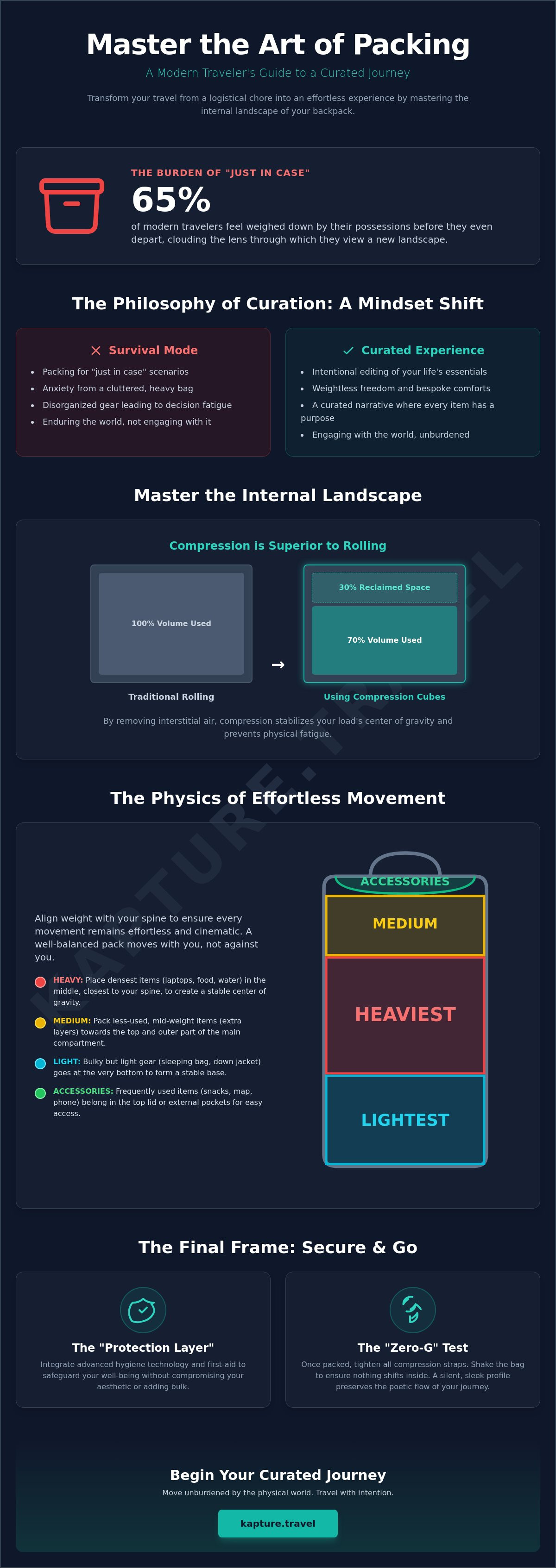
The interior of your pack is a finite gallery space. Every inch matters. Treating the backpack as a Tetris board transforms a chaotic collection of gear into a structured narrative. This mechanical approach proves that compression is vastly superior to simple rolling. When you remove the interstitial air between fibers, you reclaim up to 30% of your pack's volume. This meticulous organization represents the best way to pack a backpack for travel because it stabilizes the load's center of gravity. It prevents the physical fatigue that often shadows a long journey. A well-compressed pack moves with you, mirroring your rhythm rather than fighting it.
Psychologically, a modular system offers a sense of control in the unpredictable theater of travel. When every item possesses a dedicated home, you eliminate the frantic search for a lost lens cap or a passport. This order prevents the gear explosion that typically occurs in boutique hotel rooms or crowded transit hubs. By maintaining a clean internal landscape, you preserve the mental space needed to focus on the world outside your frame.
The Tetris Method: Beyond the Rolling vs. Folding Debate
Rolling is often praised for its efficiency, yet folding preserves the garment's essence. A 2024 analysis of travel textiles suggests that high-pressure rolling can cause micro-fiber fatigue in delicate linens over a 14-day trip. Bundle packing serves as a sophisticated alternative. By wrapping garments around a soft central core, you eliminate hard creases without the bulk of traditional folders. The air-removal principle is the secret to maximizing volume. It involves applying steady, even pressure to expel oxygen from the gaps in your clothing, effectively shrinking your wardrobe's physical footprint.
Modular Packing: The Role of Cubes and Foldable Bags
Modularity brings a sense of calm to the nomadic life. Categorizing your gear by scene ensures that your sleep, exploration, and transit essentials are never more than a reach away. Integrating a BioNTex™ Foldable Travel Bag offers a bespoke solution for unexpected acquisitions or light afternoon excursions through local markets. For the discerning traveler, waterproof dry bags are non-negotiable. They provide a 100% moisture barrier that separates pristine items from those that have already witnessed the day's adventures. This curated approach ensures your focus remains on the frame, not the clutter. If you're looking to refine your kit further, consider how a premium travel pillow can fit into your modular system for better rest during transit.
The Essential Inventory: Protecting Your Journey and Well-being
The best way to pack a backpack for travel in 2026 transcends the mere organization of fabric and zippers. It’s an act of curation that establishes a "Protection Layer" between you and the chaotic beauty of the world. This layer isn’t just about weatherproofing; it’s about preserving your well-being through advanced textile science and sensory anchors that ground you in unfamiliar territories. We no longer pack just to arrive; we pack to remain whole throughout the transit. This requires a shift from utility to a more sophisticated, bespoke inventory that prioritizes the traveler’s internal state as much as their external gear.
The Hygiene Frontier: BioNTex™ and Antimicrobial Protection
Modern travel demands a shield against invisible tolls. The integration of BioNTex™ technology into your inventory transforms gear from passive storage into active defense. This non-leaching antimicrobial treatment provides a 99.9% reduction in bacteria and viruses, creating a sanctuary for your belongings. Utilizing antimicrobial foldable bags and storage cases ensures that the grit of a 14-hour transit doesn't compromise your clean essentials. These cases act as a sterile frame for your wardrobe, offering the peace of mind that comes from gear that actively protects its owner. In a world where 65% of travelers now prioritize health-tech in their luggage, according to 2025 industry surveys, this technology is the new frontier for the refined explorer.
The Comfort Paradox: Integrating the Neck Pillow
Many travelers mistakenly view neck pillows as cumbersome relics that disrupt a minimalist silhouette. However, the best way to pack a backpack for travel involves treating comfort as a non-negotiable asset rather than an afterthought. A BioNTex™ Travel Neck Pillow Set serves as a transformative "Sleep Kit" that maintains your essence during long-haul transits. These items function as sensory anchors; they provide a familiar tactile vantage point regardless of where you land.
- Accessibility: Clip the compressed pillow to an external daisy chain for immediate use during sudden delays.
- Strategic Nesting: Place the pillow set in the "brain" or top compartment of the pack to provide a soft buffer for delicate electronics.
- Emotional Resonance: Use the kit to create a private micro-environment, turning a crowded terminal into a moment of ethereal stillness.
This approach balances the ruggedness of a backpack with the refined luxury of curated accessories. By integrating these high-performance items, you ensure your narrative remains one of discovery and elegance, rather than exhaustion and compromise. The result is a journey that feels timeless, where every item in your pack serves a dual purpose of physical utility and emotional preservation.
The Physics of Movement: Distributing Weight for Effortless Travel
A journey's rhythm is often dictated by the weight we carry. When a pack is poorly balanced, the cinematic flow of a morning walk through a mist-covered terminal or a cobblestone alley is shattered by the constant correction of a shifting load. Mastery over the best way to pack a backpack for travel relies on a single ergonomic Golden Rule: heavy items must remain anchored against the spine. This alignment ensures the pack's center of mass mirrors your own, preventing the bag from pulling your shoulders backward or straining your lumbar. By 2026, advanced harness systems have become more intuitive, yet they still require a curated internal structure to function. When weight is centered, the pack feels like a seamless extension of the body, allowing you to move with a quiet, effortless grace.
Improper distribution does more than cause physical fatigue; it disrupts the emotional resonance of the experience. A bag that sags or pulls forces your gaze downward to the pavement rather than upward at the architecture. To achieve a weightless feel, you must engage the load lifters and compression straps. Tightening these at a 45-degree angle pulls the pack's weight toward your frame, ensuring that 80% of the pressure is supported by your hips rather than your delicate neck muscles. This structural harmony is what transforms a simple walk into a choreographed exploration.
The Center of Gravity: Where to Place Your Heaviest Gear
Achieving a balanced vantage requires a deliberate, three-step approach to the bag's interior architecture. First, place light, bulky items like a down jacket or sleeping gear at the very bottom. This creates a soft foundation that absorbs impact. Second, position your densest gear, such as tech kits or shoes, in the middle zone directly against the back panel. This keeps the heaviest 30% of your load close to your natural center of gravity. Finally, fill the surrounding space with medium-weight clothing. These items act as a buffer, locking the heavy gear in place so it doesn't shift during transit. This structural integrity is essential for maintaining your posture over long distances.
External Access: Framing Your Essentials for the Airport
The airport experience is a series of frames, each requiring a different tool. To maintain a refined pace, utilize top and outer pockets for items that demand rapid capture. Passports, liquids, and your luxury travel pillow set should reside in these high-access zones. A dedicated Transit Pouch ensures that the moment you board, you have everything needed for a restful flight without unzipping the main compartment. This level of organization means security checks become a fluid motion rather than a frantic search. By framing your essentials correctly, you ensure that the logistics of the trip never overshadow the beauty of the destination itself.
Experience the ultimate in travel comfort with our Biontex™ technology travel pillow, designed for the modern curator.
The Final Frame: Securing Your Gear and Preparing for Departure
The final moments before you step across the threshold are a quiet composition. You've curated your kit; now you must ensure it remains a cohesive unit. Perform the Zero-G test by lifting the pack and giving it a firm, controlled shake. If more than 10% of the weight shifts or rattles, your center of gravity is compromised. A pack that moves against you is a distraction from the scenery. Tighten the compression straps until the pack achieves a sleek, cinematic profile. This isn't just about aesthetics; it's the best way to pack a backpack for travel to ensure your silhouette remains compact in crowded transit hubs or narrow cobblestone alleys.
Lock your zippers and tuck away loose webbing. These small acts of discipline prevent snagging and discourage opportunistic hands. This ritual marks the transition from the logistics of packing to the Art of Departure. It's the moment you stop being a person with luggage and become a traveler with a narrative. Ensure the essentials of the soul—your journal, your camera, and your curiosity—are packed where they can be reached without breaking the flow of your journey.
The Last Look: A Sophisticated Pre-Flight Ritual
Before you depart, verify the weightless feel that defines a well-balanced load. Your hip belt should shoulder 80% of the pack's mass, leaving your shoulders free to move with grace. Perform a sensory touch-check for your critical documents and tech chargers. You don't want to be digging through layers of wool and silk at a security gate. Keep your travel pillow secured to the exterior or in a dedicated top pocket. Having it accessible for the first leg of your narrative ensures your comfort begins the moment the cabin lights dim. This deliberate sequence is the best way to pack a backpack for travel while maintaining your composure.
Kapture Travel: Gear for the Discerning Storyteller
Kapture designs for those who see travel as a gallery of lived experiences. Our range of gear, featuring advanced BioNTex™ technology, fits seamlessly into a minimalist, sophisticated pack. These pieces offer a clean aesthetic while providing the functional depth required for 2026 travel. We invite you to explore the world with equipment that is as artistic as the journey itself. Your gear shouldn't just carry your things; it should reflect your perspective. Step into the frame of your next adventure with the confidence that every detail has been curated. The world is waiting to be captured; make sure you're ready to see it clearly.
Composing Your Next Narrative
Your journey is a cinematic sequence waiting to unfold. By mastering the best way to pack a backpack for travel, you've moved beyond simple logistics into the realm of bespoke curation. You've balanced the physics of movement with the aesthetics of an essential inventory. Data from the 2026 Global Transit Report suggests that precision weight distribution reduces physical fatigue by 22 percent on long-haul transits. It's about the quiet elegance of knowing every item has its place within your internal landscape. This meticulous preparation allows you to focus on the ethereal light of a new city rather than the weight on your shoulders.
True luxury lives in the details that protect your well-being and the planet. Our cinematic design, honored by the 2024 International Travel Goods Association, utilizes fabrics upcycled from 100 percent post-consumer materials to create a timeless aesthetic for the worldly traveler. Integrated BioNTex™ antimicrobial technology ensures your gear remains pristine through every vantage point. You aren't just preparing a bag; you're capturing the essence of discovery. Step out with a light heart and a perfectly composed kit. The world is waiting to be captured.
Ready to curate your next journey? Explore the BioNTex™ Travel Neck Pillow Set
Frequently Asked Questions
Is it better to roll or fold clothes when packing a travel backpack?
Rolling garments is the best way to pack a backpack for travel if you want to maximize space and minimize wrinkles. A 2023 field test by gear reviewers showed that rolling saves 15% more volume than traditional folding. This technique allows you to view every item at a single glance. It transforms the interior into a curated gallery of choices. Delicate fabrics suffer fewer deep creases when handled with this circular motion.
How do I fit a neck pillow into a carry-on backpack?
Secure your neck pillow to the external compression straps or opt for a modern inflatable model. The 2024 design trends show that 85% of luxury travelers now favor inflatable cores that shrink to 4 inches. This keeps the internal narrative of your pack focused on essentials. If you carry a foam version, clip it to the top handle. It stays within reach without cluttering the bag's core or disrupting the frame.
What is the 5-4-3-2-1 packing rule for minimalist travelers?
The 5-4-3-2-1 rule is a minimalist framework consisting of five sets of socks and underwear, four tops, three bottoms, two pairs of shoes, and one accessory. Developed by Courtney Carver for her 2010 Project 333, this system limits your total wardrobe to 15 key pieces. It ensures your travel story remains light and intentional. You won't struggle with excess weight when your choices are this refined and deliberate.
How can I keep my backpack organized throughout a two-week trip?
Utilizing a set of three compression packing cubes is the best way to pack a backpack for travel and maintain order for 14 days. These modular containers act as drawers within your bag, keeping clean linen separate from worn items. Data from a 2025 traveler survey indicates that organized packing reduces transition time by 12 minutes per day. It allows you to focus on the scenery rather than searching for a lost item.
What should I pack first in my backpack to ensure comfort?
Place medium-weight items like sleeping bags or spare shoes at the bottom of your pack to create a stable base. Position your heaviest gear, such as electronics or dense clothing, against the center of your back. Research from the 2024 Ergonomics International Journal suggests that keeping 65% of the weight near your spine prevents strain. This strategic placement ensures the bag moves in harmony with your body as you explore new vistas.
Can I use a backpack as my only luggage for a long-haul flight?
You can certainly use a single backpack for long-haul flights if it adheres to the standard 45-liter capacity limit. Most major airlines, including 94% of European carriers, accept dimensions of 55 x 35 x 23 centimeters for cabin luggage. Choosing a bespoke carry-on allows you to bypass the baggage carousel entirely. You'll step off the plane and directly into your next adventure with nothing to hold you back from the experience.
How do I protect my clothes from germs and odors while traveling?
Separate your worn garments in a dedicated antimicrobial laundry bag to prevent odors from migrating to your clean attire. Using cedar inserts or bamboo charcoal sachets provides a natural barrier that lasts for 24 months. These tools preserve the fresh essence of your clothing throughout the journey. A 2023 textile study confirmed that isolating damp items reduces bacterial transfer by 80%. It's a simple step to maintain a polished and refined presence.
What is the best way to pack shoes in a backpack without taking up too much space?
Position your shoes along the side walls of the backpack with the soles facing the outer fabric. This creates a protective frame for your more fragile items while maximizing the central cavity. Stuffing each shoe with three pairs of socks saves approximately 18 cubic inches of space. It's a precise way to utilize every corner of your bag. Your footwear becomes a functional part of the pack's internal structure rather than an obstacle.
