
The Art of the Arrival: A Sophisticated Guide on How to Avoid Jet Lag in 2026
The most profound luxury of modern travel isn't the destination itself, but the clarity of mind you bring to it. You've likely felt that spectral fog that settles in after a long-haul flight, where the world feels muted and the focus of your experience is blurred by exhaustion. It's a common struggle to understand how to avoid jet lag while the world moves faster than our biology can follow. Crossing continents shouldn't mean losing the first few days of your journey to a haze that dulls the vibrant colors of a new landscape.
I'll help you master the rhythms of displacement and reclaim your journey with a curated approach to travel wellness and circadian synchronization. We will examine how $179 sleep recovery lamps, high-performance gear like the BioNTex™ Travel Neck Pillow Set, and personalized timing can adjust your internal exposure and transform your arrival into a moment of pure, cinematic discovery. From the precision of light therapy to the quiet comfort of refined storage solutions, this guide provides the toolkit you need to stay present and preserve the emotional resonance of every mile traveled.
Key Takeaways
- Orchestrate your internal clock by adopting the 90-minute incremental sleep rule for a seamless transition between time zones.
- Master the art of how to avoid jet lag through the 'False Departure' ritual; a deliberate mental clearing that begins 48 hours before your journey.
- Transform the cabin into a private sanctuary of rest using ergonomic tools that prioritize spinal alignment and physical recovery.
- Anchor your senses upon arrival with the 'First Light' ritual to synchronize your biological clock with the natural local landscape.
- Elevate your travel experience by viewing every journey through a lens of artistic appreciation and sustainable, curated craftsmanship.
The Rhythms of Displacement: Understanding the Science of Jet Lag
Travel is an act of translation. When we leap across longitudes, our biological rhythms are forced to interpret a new dialect of light and shadow before they're ready. This physiological dissonance is more than a mere inconvenience. It's a fundamental break in our internal choreography. By Understanding the Science of Jet Lag, we begin to see our bodies not as machines, but as delicate instruments sensitive to the earth's rotation. The pineal gland and the suprachiasmatic nucleus work in tandem to conduct our daily symphony, and when that harmony fractures, the world loses its luster.
Crossing the three time zone threshold is where displacement becomes a physical weight. You don't just feel tired; you feel disconnected. Your digestion shifts, your focus blurs, and the emotional resonance of your destination can feel muted, as if you're viewing a masterpiece through a dusty lens. Learning how to avoid jet lag is about reclaiming that clarity so you can experience the world with a sharp, artistic perspective from the moment you land.
To better understand this biological shift, watch this helpful guide on navigating long-haul travel:
The Circadian Master Clock
The suprachiasmatic nucleus (SCN) acts as the brain's primary light meter. It responds to the blue hues of morning and the amber glow of dusk to regulate our vitality. Circadian rhythm is the silent metronome of human vitality. However, the artificial environment of a pressurized cabin can distort these cues. High altitudes create a physical stress that compounds the temporal shift. Supporting your body with ergonomic tools like the BioNTex™ Travel Neck Pillow Set helps maintain physical alignment, which is crucial for the restorative rest needed to buffer these biological shocks.
Eastward vs. Westward Transitions
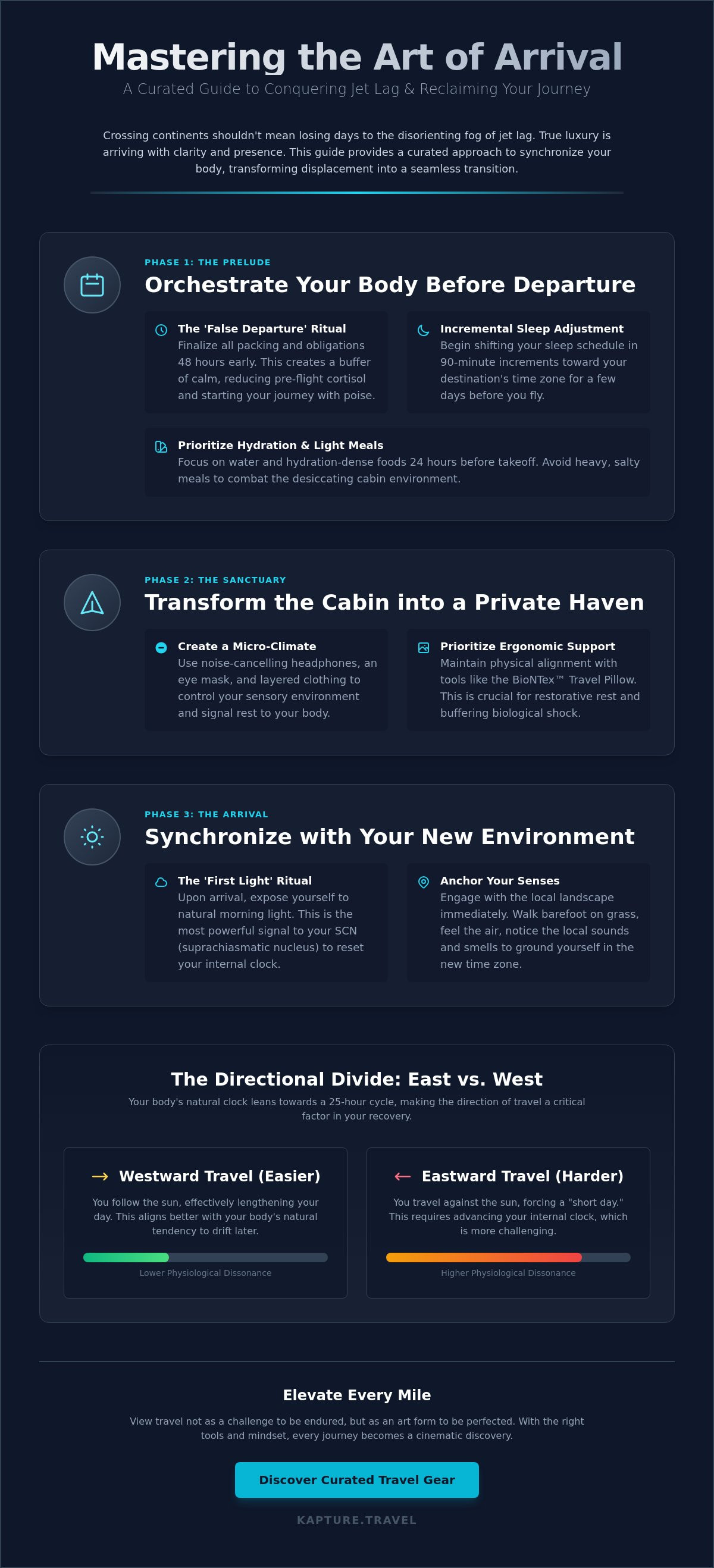
Our internal clocks naturally lean toward a 25-hour cycle, making westward travel feel like a gentle extension of the day. We follow the sun, stretching the light. Eastward leaps are far more taxing on the spirit because they force a "short day," requiring us to advance our rhythms against our natural inclination. This "vibe shift" requires more than just willpower. It demands strategic light exposure and mental anchoring. When you master how to avoid jet lag during these difficult eastward bounds, you turn a period of recovery into a moment of graceful transition, ensuring you arrive ready to document every evocative detail of your journey.
The Prelude: Orchestrating Your Body for the Time Shift
The journey doesn't begin at the boarding gate. It starts in the quiet, deliberate hours before you ever leave your doorstep. To truly understand how to avoid jet lag, you must treat the days leading up to a flight as a sacred prelude. This is the time to clear the mental deck. Most travelers spend their final hours in a frantic rush, creating a surge of cortisol that fractures their internal baseline before the trip even begins. Instead, we advocate for the "False Departure" ritual. This is a concept where your mental and logistical preparation concludes 48 hours early, creating a buffer of calm that allows you to enter the cabin with poise.
Nutrition plays a silent but significant role in this orchestration. In the 24 hours before takeoff, shift your focus toward light, hydration-dense meals. Avoid the heavy, salt-laden foods that often characterize airport dining. By prioritizing cellular hydration early, you provide your body with the resilience needed to withstand the desiccating environment of a high-altitude cabin. Following Harvard Medical School's guide to avoiding jet lag, these early adjustments are vital for staying alert and reducing the physical toll of crossing multiple time zones.
The 48-Hour Sacred Window
Implementing a luxury mindset means reclaiming your time. Avoid the hectic last night by finalizing your packing and professional obligations two days prior. This ritual isn't just about logistics; it's a psychological shift that signals to your nervous system that the journey has begun. When you use a BioNTex™ Foldable Storage Bag to organize your essentials, you eliminate the friction of search and discovery. Everything has its place. This order allows you to spend your final night at home in a state of quiet reflection, perhaps enjoying a final meal in your current time zone with full presence.
Strategic Sleep Shifting
The biological clock is a rhythmic masterpiece that doesn't appreciate sudden shocks. Instead of trying to adjust all at once, utilize the 90-minute rule for pre-flight synchronization. Over the course of three days, advance or delay your bedtime in 30-minute increments. If you're traveling east, go to bed earlier; if west, stay up a bit later. This gradual shift makes the eventual displacement feel like a natural progression rather than a violent disruption. During this time, be mindful of blue light exposure. Use the evening hours to dim the lights and create a sleep sanctuary that primes your body for deep rest. This subtle choreography is a key component of how to avoid jet lag, ensuring that by the time you reach the aircraft, your internal metronome is already beating in time with your destination.
The Sanctuary of the Cabin: Creating a Personal Micro-Climate
Once the aircraft door seals, you enter a suspended state. The cabin environment is notoriously dry and cramped, a sensory challenge that can exacerbate the physical toll of long-distance travel. To master how to avoid jet lag, you must view your seat not as a constraint, but as a laboratory for recovery. It's about creating a personal micro-climate that shields you from the chaotic hum of the engines and the fluctuating temperatures of the cabin. This is where the transition becomes tangible. Every choice you make, from your posture to your protection, dictates how you'll feel when the wheels finally touch the tarmac in a distant land.
Rest in the air is a tactical necessity. It's the bridge between the person you were at departure and the refreshed traveler you intend to be upon arrival. By treating your time in the air as a period of active recovery, you ensure that your biological clock has the best possible chance to synchronize with your new reality. This requires a shift in perspective, moving away from merely "enduring" a flight and toward a curated experience of quiet, restorative elegance.
Ergonomics as an Art Form
Proper neck support is the cornerstone of deep rest. Without it, the body suffers from "micro-awakenings." These are those jarring moments when your head drops and your nervous system spikes, pulling you out of a restorative state before you can reach REM sleep. This prevents the brain from entering the deeper stages of the sleep cycle required for cognitive clarity. The BioNTex™ Travel Neck Pillow Set provides the structural integrity needed to maintain spinal alignment. It allows your muscles to fully disengage, signaling to your brain that it's safe to rest deeply. When your body feels secure, your mind follows. This psychological comfort is amplified by wearing a dedicated "travel uniform" from a curated collection of breathable apparel, turning your personal space into a tactile sanctuary that feels familiar even at thirty thousand feet.
The BioNTex™ Protection Layer
In a shared space, mental peace is often tied to a sense of cleanliness. Understanding the BioNTex™ technology reveals how a specialized textile treatment can create a safer, more hygienic environment. This antiviral and odor-resistant layer ensures that your immediate surroundings remain fresh throughout the longest hauls. It removes the invisible stressors of a stale cabin environment. A hygienic sanctuary allows for deeper, more restorative sleep by providing a sense of exclusivity and care. Following NHS tips for managing jet lag, you should also focus on strategic hydration. This means moving beyond mere sips of water to focus on cellular recovery. Avoid the caffeine and alcohol that disrupt the delicate balance of your internal clock. By curating your cabin experience with intention, you transform a grueling flight into a moment of refined preparation.
Chasing the Light: Post-Arrival Synchronization Rituals
The wheels touch down. The air smells of a different hemisphere. This is the critical moment where your biological metronome must align with the local tempo. To master how to avoid jet lag, you must become a deliberate seeker of light. The morning sun isn't just a scenic backdrop; it's a high-resolution signal to your suprachiasmatic nucleus that a new day has begun. This 'First Light' ritual serves as the primary anchor for your circadian rhythm, pulling your internal clock out of the shadows of displacement and into the present. It's an act of biological recalibration that requires both patience and precision.
Strategic napping is a delicate art that many travelers misinterpret. While the urge to succumb to a deep, midday slumber is powerful, it's often a trap that resets your clock to the wrong time zone. Instead, embrace the 20-minute 'power pause.' This brief duration provides a cognitive refresh without entering the deep sleep cycles that lead to post-nap grogginess. It's a momentary reset, allowing you to maintain your momentum until the evening. As the day ends, transition into a digital detox. Sensory cooling, both through temperature and light, prepares your mind for the deep, restorative rest that truly anchors you to your new location.
The Phototherapy Protocol
Natural sunlight is the most potent tool in your recovery arsenal. Its spectral composition is far more effective than any artificial source at resetting your internal clock. If you've traveled east, seek bright morning light and avoid the harsh glare of the late afternoon sun. Conversely, westward travelers should chase the late afternoon rays to delay their internal clock. When the sky is overcast or you're confined indoors, strategic blue light exposure from specialized devices can serve as a functional substitute, mimicking the sky's natural luminescence to keep your alertness sharp during your new "daylight" hours.
Movement and Metabolism
Synchronization is a holistic effort that involves your entire system. Align your meal times with the local clock immediately upon arrival, even if your appetite hasn't quite caught up. This tells your digestive system that the transition is complete. A light, contemplative walk through a local park or neighborhood does more than just offer a first glimpse of your surroundings. It stimulates circulation and reduces the edema often associated with long flights. The goal is simple but demanding: stay awake until at least 9:00 PM local time. This discipline ensures that your first full night of sleep is deep and transformative, allowing you to wake up feeling present and refreshed.
Prepare for your first sunrise walk with a BioNTex™ Foldable Backpack, designed to carry your camera and essentials with effortless elegance as you document your arrival.
The Kapture Travel Philosophy: Elevating the Modern Journey
Travel is a transformative act of translation, a deliberate choice to step into the unknown with a spirit that is both vulnerable and resilient. In the pursuit of how to avoid jet lag, we discover that the most enduring luxury is the ability to remain fully present as the world unfolds in new and unexpected ways. It's about more than just managing fatigue; it's about respecting the soul of the journey and ensuring that the first light of a new destination isn't lost to a spectral fog. When you approach displacement with intention, every mile becomes an opportunity for refined discovery.
A Legacy of Sustainable Exploration
Kapture Travel prioritizes sustainability through a meticulous selection of upcycled fabrics, proving that high-end design and environmental stewardship can exist in perfect harmony. By choosing materials that have been thoughtfully repurposed, the brand ensures that your global explorations contribute to a narrative of preservation rather than consumption. This focus on sustainability reflects a deeper understanding of the traveler’s impact on the world, inviting you to build a legacy of conscious discovery that honors both the destination and the act of documentation.
Curating Your Wellness Toolkit
The final element of a successful arrival is the assembly of a toolkit that supports your body’s natural resilience against the pressures of high-altitude transit. The BioNTex™ Travel Neck Pillow Set serves as the anchor of this collection, providing the sanctuary needed to maintain focus across continents. To ensure a seamless transition and maintain an organized, aesthetic presence, the discerning traveler integrates several key pieces into their ritual:
- BioNTex™ Foldable Travel Bag: A masterpiece of utility and elegance for your curated essentials.
- Crossbody Puffy Bag: Designed for intimate access to your most valued items during the flow of transit.
- BioNTex™ Foldable Shoe Cases: Preserving the integrity of your wardrobe with hygienic, protective precision.
Discover the BioNTex™ Travel Pillow Set and redefine your next crossing. By aligning your gear with the sophisticated strategies for how to avoid jet lag discussed throughout this guide, you ensure that every journey is met with the quiet elegance and physical clarity it deserves. Step into the world with a perspective that is clear, refreshed, and entirely your own.
Master the Art of the Present Arrival
Every journey is a sequence of moments that deserve to be witnessed with clarity and a sharp, observant eye. By orchestrating your biological rhythms through strategic light exposure and prioritizing your physical sanctuary within the cabin, you transform travel from a logistical hurdle into a ritual of quiet refinement. Mastering how to avoid jet lag is ultimately about preserving the emotional resonance of your destination. It ensures that your first steps on a new shore are taken with full presence and a spirit ready for discovery. It's a testament to your respect for the experience itself.
Your gear should be as purposeful as your itinerary. The intersection of BioNTex™ Antiviral Technology and a Red Dot-level design aesthetic provides a protective, elegant layer for the modern explorer. Each piece is crafted from upcycled, sustainable materials, reflecting a commitment to both personal wellness and global stewardship. Elevate your travel sanctuary with the BioNTex™ Travel Pillow Set and step into your next destination with a sense of renewed vitality. The world is waiting to be seen through a lens of absolute clarity. Embrace the arrival you've meticulously curated.
Frequently Asked Questions
What is the fastest way to cure jet lag after a long-haul flight?
The fastest way to synchronize your internal clock is through immediate exposure to natural sunlight and adhering to the local time for meals and sleep. Light acts as a powerful conductor for your circadian rhythm, signaling to your brain that the journey's transition is complete. By staying active and outdoors during daylight hours, you anchor your senses to the new environment, effectively shortening the period of physical and mental displacement.
Can I avoid jet lag by changing my diet before I travel?
Shifting toward light, hydration-dense meals forty eight hours before departure can significantly prepare your body for the stress of time zone changes. Reducing salt and processed sugars helps prevent the inflammation and bloating that often accompany high altitude travel. This nutritional prelude ensures your internal baseline remains steady, making it easier to understand how to avoid jet lag by minimizing the metabolic shock of the journey.
Is it better to stay awake or sleep when I arrive at my destination?
It is almost always better to stay awake until at least 9:00 PM local time to force your body to adapt to the new schedule. If exhaustion feels overwhelming, a twenty minute power pause can provide a cognitive refresh without the risk of falling into a deep sleep cycle. Resistance is key; sleeping too early upon arrival only serves to prolong the spectral fog of displacement.
How many days does it typically take to recover from jet lag?
Recovery typically requires one day for every time zone crossed, though this varies based on individual health and travel direction. For a journey across eight time zones, your body may take over a week to fully recalibrate its internal metronome. Following a disciplined light exposure protocol and using ergonomic support can often accelerate this timeline, helping you reclaim your focus and presence more quickly.
Do melatonin supplements actually help with time zone changes?
Melatonin supplements can be effective for resetting your sleep cycle, though they are not currently FDA-approved specifically for the treatment of jet lag disorder as of 2026. These supplements, often available for as little as five cents per tablet, serve as a chemical signal for darkness. They are most useful when traveling east, helping you advance your internal clock to meet the shorter day of your destination.
What are the most effective ways to stay hydrated on a flight?
Effective hydration involves more than just drinking water; it requires maintaining electrolyte balance and avoiding diuretics like caffeine and alcohol. Focus on cellular recovery by consuming water steadily throughout the flight rather than in large bursts. This consistent intake helps combat the desiccating cabin air, ensuring your skin and spirit remain vibrant as you cross continents and prepare for your arrival.
Why is jet lag worse when traveling from West to East?
Traveling east is more taxing because it forces a "short day," requiring your body to advance its natural twenty five hour internal cycle. When you lose hours, your biological clock struggles to compress its rhythms to catch up with the sun. This creates a more profound sense of dissonance compared to westward travel, where the day is simply extended, allowing for a more graceful and intuitive adaptation.
How does a travel neck pillow help with jet lag recovery?
A high quality travel neck pillow provides the ergonomic integrity needed to prevent micro awakenings that disrupt deep, restorative rest. By maintaining spinal alignment, tools like the BioNTex™ Travel Neck Pillow Set signal to your nervous system that it is safe to disengage. This physical security, combined with antiviral fabric technology, creates a hygienic sanctuary that allows you to master how to avoid jet lag and arrive feeling refreshed.
