
The Art of the Restful Journey: How to Choose a Travel Neck Pillow in 2026

The most exquisite destinations in the world will not save you from arriving with a stiff neck, a fog of exhaustion, and the quiet frustration of having slept through a sunrise you'd been anticipating for months. That particular disappointment is one every seasoned traveler knows intimately, and it rarely has anything to do with the flight itself. It has everything to do with what was, or wasn't, cradling your cervical spine at 35,000 feet.
You already know that rest is not a luxury on a long journey; it's a prerequisite for experiencing anything at all. The question of how to choose a travel neck pillow, then, is far more consequential than it first appears. It is not simply a matter of foam density or price point. It's a question of ergonomic integrity, sensory comfort, and the quiet confidence of knowing the fabric against your skin is as clean and considered as the itinerary you've spent months composing.
This guide moves through every dimension of that decision with deliberate care, from the architecture of genuine cervical support and the science of protective textile technology, to the understated elegance a well-chosen pillow brings to the entire ritual of travel.
Key Takeaways
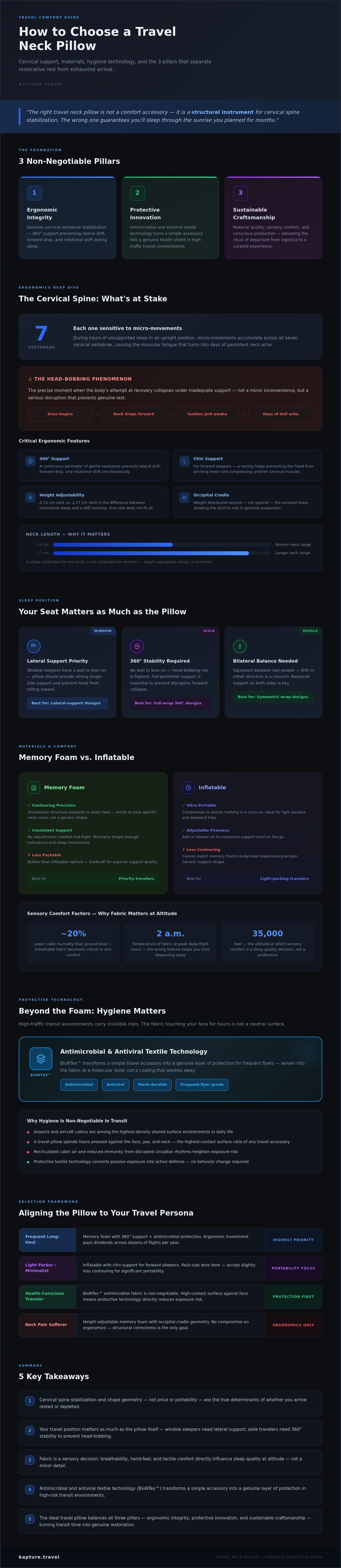
- Knowing how to choose a travel neck pillow goes far beyond price or portability — cervical spine stabilization and shape geometry are the true determinants of whether you arrive rested or depleted.
- Your travel position matters as much as the pillow itself: window sleepers require lateral support, while aisle travelers need 360-degree stability to prevent the disruptive head-bobbing phenomenon.
- The fabric against your skin is not a minor detail — breathability, hand-feel, and tactile comfort directly influence sleep quality at altitude, making material selection a sensory decision as much as a practical one.
- High-traffic transit environments carry invisible risks; antimicrobial and antiviral textile technology, such as BioNTex™, transforms a simple travel accessory into a genuine layer of protection for frequent flyers.
- The most considered travel pillows balance three non-negotiable pillars — ergonomic integrity, protective innovation, and sustainable craftsmanship — elevating the entire ritual of departure from mere logistics to a curated experience.
Understanding the Anatomy of a Restful Transit
A travel pillow is not, at its core, a comfort accessory. It is a structural instrument. Its primary role is cervical spine stabilization: the deliberate, sustained cradling of the neck vertebrae in a position that allows the surrounding musculature to release entirely, surrendering the vigilant tension that waking life demands. The secondary role is sensory, creating a quiet architecture around the body that signals, with some authority, that this particular stretch of time belongs to rest and not to transit.
These two functions are inseparable. One without the other produces the familiar half-sleep of long-haul travel: the doze interrupted by a sudden lurch, the neck snapping forward, the slow return of consciousness accompanied by a dull ache that will persist for days. This is the head-bobbing phenomenon, and it is not a minor inconvenience. It is the precise moment when the body's attempt at recovery collapses under the weight of inadequate support. The right pillow geometry interrupts this cycle entirely, holding the head in a stable, neutral position so that even turbulence doesn't translate into a jarring awakening.
Understanding how to choose a travel neck pillow, then, begins here: not with fabric softness or compressed pack size, but with the question of whether a given design can genuinely prevent that collapse.
The Ergonomics of the Cervical Spine
The cervical spine is composed of seven vertebrae, and each one is sensitive to the micro-movements that accumulate during hours of unsupported sleep in an upright position. A pillow offering true 360-degree support doesn't simply pad the back of the neck; it creates a continuous perimeter of gentle resistance that discourages lateral drift, forward drop, and rotational shift simultaneously. For those who naturally lean forward during sleep, integrated chin support becomes non-negotiable, providing a resting ledge that prevents the head from pitching downward and compressing the anterior cervical muscles. Height-adjustable features address the equally significant variable of neck length: a pillow calibrated for one body is not calibrated for another, and the difference between a 13-centimeter neck and a 17-centimeter one is the difference between restorative sleep and a stiff morning.
Weight Distribution and Pressure Points
The occipital bone, the rounded protrusion at the base of the skull, is where most poorly designed pillows fail. Pressing against it rather than cradling beneath it pushes the entire head forward, replicating the very posture the pillow was meant to correct. A well-engineered travel pillow distributes weight around the occipital bone, not against it, allowing the skull to rest in genuine suspension. Tapered ends matter here too: in high-backed airline seats, a pillow that's too wide at its edges creates a wedging effect that forces the head into an unnatural forward tilt. Ergonomic neutrality is the state where the neck muscles are fully relaxed, neither bracing against collapse nor straining against overcorrection, and it is the quiet standard against which every design decision should be measured.
This is the emotional architecture of what serious travelers increasingly call a travel sanctuary: a self-contained envelope of physical ease and sensory calm that transforms the dead hours of transit into something closer to genuine restoration. The journey, in this sense, doesn't begin at the destination. It begins the moment the right gear allows the body to finally let go.
The Sensory Selection: Materials, Textures, and Breathability
Structural support, as the previous section established, is the foundation. But the body doesn't experience a pillow as an engineering diagram. It experiences it as sensation: the weight of it against the jaw, the temperature of the fabric at 2 a.m., the subtle resistance when the head shifts during a dream. These are the details that determine whether sleep deepens or stays frustratingly shallow, and they deserve the same analytical rigor as any ergonomic specification.
Memory Foam vs. Inflatable: A Comparative Study
Memory foam remains the most reliable choice for travelers who prioritize contouring precision. Its viscoelastic structure responds to body heat, gradually conforming to the specific curve of an individual neck rather than offering a generic approximation of support. On trains or older aircraft where vibration is a constant companion, foam's natural dampening properties absorb that low-frequency tremor before it reaches the cervical spine. The limitation is honest and worth naming: standard memory foam traps heat with remarkable efficiency, and a pillow that begins the journey feeling luxurious can become a source of genuine discomfort within a few hours of cabin warmth.
Inflatable cores solve the packing problem elegantly. They compress to almost nothing, slip into a coat pocket, and offer adjustable firmness that no fixed-density foam can replicate. What they sacrifice is tactile comfort. The surface of an inflatable pillow tends to feel clinical, and the slight give of pressurized air doesn't replicate the grounded, absorbed quality that foam provides. For a weekend trip with a single carry-on, the trade-off is reasonable. For a fourteen-hour flight, it's a compromise that registers in the body.
Hybrid structures address this tension with quiet intelligence, pairing a supportive inner core with an outer layer engineered for sensory comfort. This is the direction that considered travel accessories are moving in, and it reflects a broader understanding that knowing how to choose a travel neck pillow means refusing to accept that portability and comfort must be mutually exclusive.
The Fabric Interface: Beyond the Surface
The cover fabric is where most travelers stop thinking critically, and where the experience of a long journey is most immediately felt. Hand-feel, the tactile quality of a material against bare skin, is not a superficial concern. Rough weaves, synthetic sheens, and fabrics that generate static all interfere with the body's ability to fully release into sleep. Natural-feel upcycled fabrics address this at a material level, offering a softness that doesn't degrade after repeated use while carrying the added dimension of considered provenance.
Moisture-wicking properties solve the problem that nobody discusses in polite company: the slow accumulation of heat and perspiration at the neck during a long flight. Cabin humidity is low, but the microclimate between skin and fabric is not, and a pillow that can't move moisture away from the skin will eventually wake you with a clammy discomfort that no amount of reclined seat adjustment will fix. Breathable, performance-oriented fabrics interrupt this cycle before it begins.
The shift toward upcycled materials represents something beyond environmental responsibility, though that dimension is real and significant. It reflects a curatorial sensibility: the understanding that the materials surrounding the body during rest carry their own story, their own craft, and that this matters to travelers who approach a journey as an aesthetic experience rather than a logistical exercise. A fabric with genuine origin is a fabric with character, and character, it turns out, is something the skin recognizes.
For those ready to experience this convergence of sensory intelligence and protective innovation, the BioNTex™ Travel Neck Pillow Set offers a considered starting point where material integrity and functional design arrive as a single, unified proposition.
Beyond the Foam: Hygiene and Protective Technology
There's a conversation that happens frequently in travel forums and rarely in polished buying guides. It goes something like this: someone asks about keeping their pillow clean, and the most upvoted response is, invariably, "just wash the cover when you get home." It's practical advice. It's also entirely insufficient. The problem isn't what accumulates on a travel pillow over weeks; it's what accumulates during a single journey, in a single terminal, across a single fourteen-hour flight.
Consider the environment. Airport seating surfaces, overhead bin interiors, tray tables, and armrests are among the highest-traffic contact points in the built world. A travel pillow resting against any of these surfaces, or simply existing in the same recirculated cabin air, is not a passive object. It's a collection point. The question of how to choose a travel neck pillow, when examined honestly, must eventually arrive here: at the invisible dimension of what the fabric is doing when it isn't actively cradling your neck.
For frequent flyers, this isn't an abstract concern. It's a cumulative exposure question with real consequences for immunity, skin sensitivity, and the kind of low-grade fatigue that arrives not from jet lag but from the quiet physiological cost of constant transit.
The BioNTex™ Innovation
The most significant development in travel pillow technology in recent years isn't a new foam density or a more elegant clasp. It's the emergence of fabric treatments that actively neutralize pathogens on contact rather than simply resisting surface moisture. BioNTex™ technology operates on this principle: a protective layer integrated into the textile itself, designed to address bacteria and viruses at the surface level, continuously, without requiring the traveler to do anything at all.
For travelers with sensitive skin or compromised immune systems, this distinction is significant. Passive hygiene, the kind that relies on post-trip washing, offers no protection during the journey. An active, self-sanitizing surface changes the relationship between the traveler and their environment in a way that's genuinely consequential. It transforms the pillow from a comfort accessory into a considered layer of protection, as deliberate in its function as a well-fitted mask or a carefully chosen hand sanitizer.
There's also a psychological dimension that shouldn't be underestimated. Resting in a crowded economy cabin, or even a premium one, carries a background hum of ambient unease for many travelers. The quiet confidence of knowing the fabric against your skin is actively working in your favor allows the body to release that vigilance entirely. Protected rest isn't a marketing phrase; it's a measurable state of physical ease. And ease, as any experienced traveler knows, is the prerequisite for genuine sleep.
Maintenance and Longevity
Protective textile technology carries a secondary benefit that's easy to overlook: it reduces the frequency of aggressive washing cycles that degrade fabric integrity over time. When a surface is actively inhibiting microbial accumulation, the intervals between necessary cleaning extend naturally, and the cleaning itself can be gentler. The ideal maintenance routine for a high-performance travel accessory involves regular, mild washing of a removable outer shell, one designed to retain its shape, its softness, and its protective properties through repeated laundering, rather than the aggressive scrubbing that a standard pillow cover eventually demands. A removable shell that holds its structure after cleaning isn't a minor convenience; it's the difference between an accessory that ages gracefully and one that quietly deteriorates into something you'd rather not press against your face at altitude.
Aligning the Pillow with Your Travel Persona
The single-pillow-for-all-travelers assumption is one of the more persistent myths in travel accessory marketing. It treats a deeply individual experience, the specific geometry of how your body surrenders to sleep at altitude, as though it were a universal constant. It isn't. The window sleeper and the aisle traveler inhabit fundamentally different physical environments, and knowing how to choose a travel neck pillow means beginning with an honest assessment of which one you are.
Four distinct travel personas emerge from this framework, each with its own ergonomic priorities and aesthetic sensibilities.
- The Window Dreamer has a wall to lean against, which changes everything. The fuselage provides a fixed lateral surface, so the priority shifts from 360-degree containment to single-sided depth. A pillow with pronounced lateral support on one side, thick enough to bridge the gap between shoulder and temple without forcing the neck into a sharp angle, is the defining requirement. Symmetrical designs are a compromise here; asymmetrical or side-specific geometries serve this sleeper far more honestly.
- The Aisle Observer has no such anchor. Without a wall, the head is entirely dependent on the pillow's own structural perimeter to resist gravitational drift in any direction. Full 360-degree stability isn't a premium feature for this traveler; it's the baseline condition for sleep at all. A chin support component becomes particularly valuable, preventing the forward drop that a window seat's fuselage would otherwise interrupt.
- The Minimalist Curator refuses the false choice between packability and performance. Foldable designs that compress without losing their structural memory, recovering their full ergonomic depth within moments of deployment, represent the only acceptable answer. A pillow that arrives deflated and performs accordingly is not a minimalist solution; it's a compromise dressed in compact clothing.
- The Artistic Voyager understands that the objects carried through the world are a form of self-expression. The journey is an aesthetic experience from departure gate to arrival hall, and every element of the kit should reflect that sensibility.
Seat Selection and Pillow Synergy
Modern aircraft cabin headrests in 2026 configurations vary considerably between narrow-body regional jets and wide-body long-haul carriers. Wing-style adjustable headrests, now standard on many premium economy cabins, create a recessed support zone that actually works against thicker pillows, pushing the head forward rather than cradling it. A medium-profile pillow with a tapered rear edge integrates more cleanly with this architecture. During the upright portions of a flight, particularly during takeoff, meal service, and descent, a neck pillow repositioned against the lumbar curve of the lower back provides a secondary function that most travelers never discover: sustained spinal decompression during the long hours of enforced sitting.
The middle seat is its own discipline entirely. Hemmed in on both sides without the structural advantage of a window or the escape route of an aisle, the middle-seat traveler benefits most from a complete travel pillow set, a coordinated system that creates a personal cocoon of physical ease within an otherwise compromised spatial situation. The set approach transforms the middle seat from an endurance exercise into something approaching genuine comfort.
Style as a Functional Choice
There's a practical argument for distinctive design that rarely gets made explicitly: recognizable visual identity makes your gear findable. In the compressed chaos of an airport lounge or an overhead bin retrieval, a pillow with a strong, specific aesthetic is simply easier to locate than another anonymous grey cylinder. The Moomin collection operates on this principle with particular elegance, its characters carrying enough cultural weight to be immediately identifiable while remaining genuinely beautiful as objects in their own right.
The Kapture x Mogols collaboration extends this logic into a different register, where streetwear sensibility and premium travel function occupy the same object simultaneously. This is the intersection that defines the Artistic Voyager's approach: not decoration applied to function, but design and function arrived at together, inseparable from the start.
A well-chosen accessory doesn't simply accompany a departure. It curates one. The ritual of packing a pillow that reflects genuine aesthetic consideration, that carries a story and a craft, transforms the act of leaving into something with its own quiet ceremony. That's not a minor distinction. For travelers who understand that the journey is the destination, it's the entire point.
Explore the full range of artistically curated travel pillow sets at Kapture Travel and find the design that travels as distinctively as you do.
The Kapture Philosophy: Elevating the Ritual of Departure
Every considered journey begins with a decision: whether to treat travel as something that happens to you, or something you compose. Kapture's answer to that question is woven into every thread of its design philosophy. Three pillars hold the entire structure together: ergonomic integrity that genuinely supports the cervical spine, BioNTex™ protective technology that transforms passive fabric into an active defense, and a commitment to sustainable craftsmanship that gives each piece a provenance worth carrying. These aren't marketing categories. They're a unified position on what it means to travel well.
Understanding how to choose a travel neck pillow ultimately resolves into a single, clarifying question: do you want an accessory, or do you want an instrument? Kapture builds instruments. Objects that perform with precision, age with grace, and carry a story that accumulates with every departure stamp in your passport.
The Sustainable Choice for the Global Citizen
The environmental arithmetic of travel is already complex. The personal gear you carry through it needn't add to that weight. Kapture's use of upcycled materials isn't a gesture toward sustainability; it's a structural commitment to reducing the footprint of what the brand calls the Art of Departure. A pillow built from considered, reclaimed fabric and engineered for years of use represents a fundamentally different calculation than the foam-and-polyester cylinder purchased in desperation at a departure gate and discarded after three trips.
Durability is the quiet environmental argument that rarely gets made explicitly. A high-performance travel pillow that retains its structural integrity, its softness, and its protective properties through hundreds of journeys displaces dozens of cheap replacements. That displacement has a real cost: in raw materials, in manufacturing energy, in the slow accumulation of textile waste that the travel industry generates with remarkable indifference. Choosing quality, in this context, is not an indulgence. It's a form of restraint.
The Kapture sustainability philosophy extends this thinking into every material decision, treating the objects it creates not as products with a lifecycle, but as companions with a story. That distinction matters to travelers who understand that the things they carry reflect the values they hold.
Your Next Chapter Begins with Comfort
The final argument for investing in a genuinely considered travel pillow is the simplest one. You arrive as the person who slept, or the person who didn't. Every destination you've planned, every experience you've anticipated, every connection you've hoped to make, all of it is filtered through the quality of the rest you carried with you.
The BioNTex™ Travel Neck Pillow Set is designed with this understanding at its center. The set approach matters: a coordinated system that includes storage solutions for seamless transitions from bag to seat removes the small frictions that accumulate into genuine travel fatigue. Nothing is loose. Nothing is forgotten. The ritual of departure becomes, with the right set in hand, something closer to ceremony.
This is the Kapture proposition, stated plainly: the best journey is the one where you arrive as the best version of yourself. Rested, protected, and carrying something beautiful. That's not a minor ambition. For travelers who understand the difference between passing through a place and truly inhabiting it, it's the only one worth pursuing.
Explore the full collection and find your travel companion at Kapture Travel.
Your Next Departure Deserves Better Than Chance
Knowing how to choose a travel neck pillow is, at its core, knowing how to protect the quality of every experience waiting at the other end of the flight. The cervical spine doesn't negotiate. The skin against synthetic fabric at hour eleven doesn't lie. And the invisible environment of a high-traffic cabin doesn't pause while you sleep.
Three things matter most when the decision is made honestly: genuine ergonomic support that holds through turbulence, protective textile technology that works continuously rather than retroactively, and materials with a provenance worth carrying. BioNTex™ antiviral technology, upcycled sustainable fabrics, and artistic designer collaborations aren't separate features layered onto a product. They're a single, unified answer to what a considered travel accessory should be.
The sunrise you've been anticipating for months is still there, waiting. Arrive rested enough to see it properly.
Frequently Asked Questions
How do I know if a travel neck pillow will fit my neck size?
Measure the distance between your shoulder and the base of your skull; most adults fall between 12 and 18 centimeters, and a pillow with height-adjustable features will accommodate that range without compromise. The fit test is simple: when seated upright, the pillow should cradle the neck without pushing the chin forward or leaving a gap that allows lateral drift. If your head tilts noticeably in either direction within a few minutes, the height calibration isn't right for your anatomy.
Can BioNTex™ technology really protect me from viruses on a plane?
BioNTex™ technology is integrated directly into the textile, creating an active surface that works to neutralize bacteria and viruses on contact rather than simply repelling moisture. It's a continuous, passive defense, meaning it doesn't require any action from you to function. That said, no single layer of protection eliminates all exposure risk in a high-traffic cabin environment; BioNTex™ is best understood as a meaningful addition to your overall hygiene practice, not a replacement for it.
What is the best way to pack a memory foam travel pillow to save space?
Memory foam doesn't compress as dramatically as inflatable alternatives, so the most practical approach is to attach it externally using a luggage strap or clip it to your carry-on handle rather than forcing it inside a bag. If internal packing is necessary, place it at the top of a soft-sided bag and allow it to occupy the natural contour of the remaining space. Avoid sustained compression for more than a few hours, as prolonged pressure can temporarily affect the foam's ability to recover its full ergonomic depth.
Is a wrap-around pillow better than a traditional U-shaped one?
It depends entirely on how you sleep. Wrap-around designs offer 360-degree containment, making them the stronger choice for aisle travelers who lack a wall to lean against and need the pillow's own structure to prevent head drift in every direction. Traditional U-shaped pillows suit window sleepers well, providing reliable posterior neck support when the fuselage handles lateral stabilization. Knowing how to choose a travel neck pillow starts with this honest self-assessment, because the "better" design is always the one matched to your specific sleep position and seat location.
How often should I wash my travel pillow cover if it has antimicrobial properties?
An antimicrobial cover doesn't eliminate the need for regular washing; it extends the interval between necessary cleaning cycles and reduces microbial accumulation between washes. A practical rhythm for frequent travelers is after every two to three long-haul flights, or immediately after any journey where the pillow made prolonged contact with shared surfaces. Use a gentle, cool-water cycle to preserve both the fabric's hand-feel and the integrity of the protective treatment over time.
Are upcycled fabrics as durable as virgin materials for travel gear?
High-quality upcycled fabrics perform comparably to virgin materials in tensile strength and wear resistance, particularly when the upcycling process involves rigorous quality screening of source textiles. The durability question is less about the fabric's origin and more about the finishing and construction standards applied afterward. A well-constructed upcycled cover that retains its structure through repeated laundering and sustained use is a more durable object than a poorly finished virgin-material alternative, and it carries the added dimension of considered provenance.
Can I use my travel neck pillow for sleeping at home or in hotels?
Absolutely, and the cervical support logic that makes it effective at altitude applies equally to any upright or semi-reclined position, including reading in bed, watching a film on a hotel sofa, or recovering from a long day in transit. The antimicrobial surface properties remain active regardless of the environment, which makes it a genuinely useful object beyond the cabin. Some travelers find that the familiar sensory quality of their travel pillow, its specific weight and hand-feel, actually helps signal the body toward rest in unfamiliar hotel rooms.
Does the pillow work for children or is it strictly for adults?
Standard travel neck pillows are sized and shaped for adult cervical anatomy, and using one on a child's smaller neck can push the head into an unnatural forward position rather than supporting it. Children generally need a smaller diameter and lower profile to achieve genuine neutral alignment. If you're traveling with younger children, it's worth checking whether a junior-specific sizing option is available, or considering a small rolled blanket as a temporary substitute until a properly proportioned option can be found.
