
How to Disinfect Your Airplane Seat: The Art of the Protected Journey in 2026
What if your flight could be viewed through a lens of absolute clarity, where every surface you touch is a testament to personal care? With 5.2 billion passengers expected to fly in 2026, the reality is that cabin maintenance often focuses on the grand scale rather than the intimate details. You've likely felt that familiar hesitation before lowering a tray table or resting your head against the seatback. Learning how to disinfect your airplane seat is no longer just a chore; it's a sophisticated ritual of reclaiming your personal atmosphere and ensuring your journey remains as pristine as your destination.
We understand that the true luxury of travel lies in the peace of mind that comes from a well-composed environment. You want to move through the world with grace, not worry. This guide promises to help you master the art of the protected journey, showing you how to blend tactical hygiene with elegant, high-tech comfort. We will trace the steps of a streamlined disinfection routine and illuminate the innovative world of antimicrobial textiles, such as the BioNTex™ Travel Neck Pillow Set, designed to shield you in a cocoon of quiet confidence and enduring quality.
Key Takeaways
- Master a five-step ritual for hard surfaces and learn exactly how to disinfect your airplane seat to reclaim your personal space from the traces of those who came before.
- Uncover the "microbial map" of the modern cabin and why standard airline cleaning often prioritizes the visual over the truly pristine.
- Explore the "fabric gap" to understand why traditional wipes fail on upholstery and how to avoid the discomfort of damp, treated textiles.
- Gain insight into the continuous protection of BioNTex™ technology, a self-disinfecting advancement that works silently to maintain your sanctuary.
- Learn how to curate an elegant barrier with the BioNTex™ Travel Neck Pillow Set, blending the art of hygiene with the soul of luxury travel.
The Invisible Landscape: Why Your Seat Requires a Curated Defense
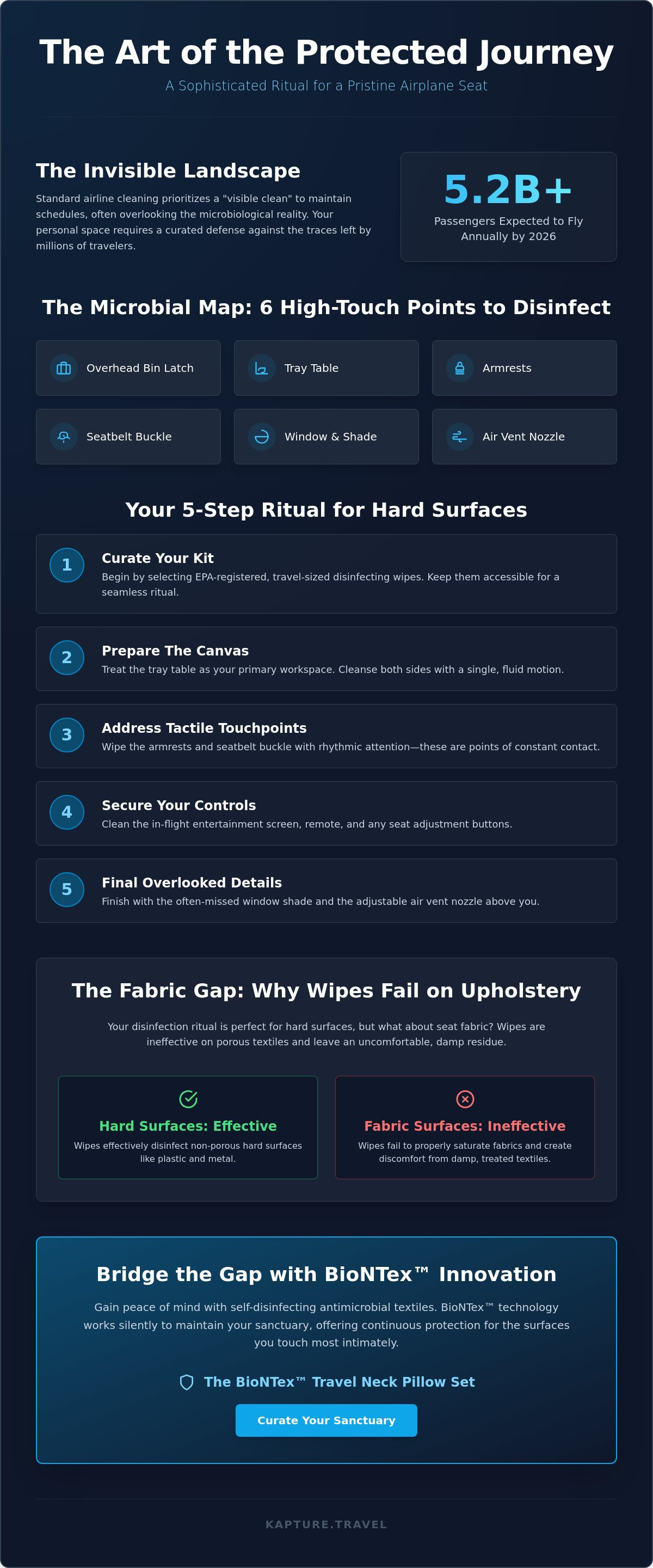
The cabin of a modern aircraft is a masterpiece of industrial design, a seamless blend of efficiency and engineered comfort. Yet, beneath the soft glow of the LED lighting and the polished surfaces of the premium cabin lies a complex microbial map. In 2026, with air travel volume reaching 5.2 billion passengers, the density of our shared journeys has created a hidden landscape that demands a closer look. Your seat is not merely a coordinate on a boarding pass; it is your private sanctuary, a singular space where you will spend the next several hours in intimate contact with materials touched by hundreds before you.
To truly settle into your journey, you must understand how to disinfect your airplane seat as a refined ritual of self-care. This process begins with a clear perspective on the environment. Before we explore the specific movements of this ritual, it's essential to understand what disinfectants are and how they serve as the first line of defense against the invisible guests left behind by previous travelers. These agents work on a molecular level to ensure that the inert surfaces of your seat are as pristine as they appear.
To better understand the practical application of these concepts, watch this helpful video:
The High-Touch Points of the Modern Cabin
Every journey begins with a series of tactile interactions. We reach for the overhead bin latch, click the seatbelt buckle, and lower the tray table to prepare for a meal or a moment of work. These represent the "Big Four" of the cabin's high-touch points. However, a seasoned traveler knows that the window shade and the air vent nozzle are often overlooked by casual cleaners. By performing a mindful cleaning ritual, you do more than just remove bacteria. You create a psychological boundary, a sense of peace that allows you to fully immerse yourself in the experience of flight. This tactical defense of hard surfaces is the first step in curating your personal haven.
The Limitations of Commercial Airline Cleaning
In the high-velocity world of 2026 aviation, airlines prioritize a "visible clean" to maintain demanding flight schedules. While top-tier carriers like EVA Air lead the world in cleanliness according to the 2025 Skytrax awards, the reality of quick turnarounds often means that deep, microbiological disinfection is reserved for overnight stays. Trash is whisked away and seat pockets are straightened, but the microscopic reality remains. This is where personal responsibility becomes the ultimate luxury. Mastering how to disinfect your airplane seat bridges the gap between the airline's operational logistics and your own standards of refinement. It acknowledges a vital distinction: tactical protection for hard surfaces and textile innovation for the porous fabrics that wipes alone cannot reach.
A Sophisticated Ritual: 5 Steps to Disinfect Hard Surfaces
Once you've crossed the threshold of the aircraft, the transition from the bustling terminal to your seat should feel like an intentional act of arrival. Mastering how to disinfect your airplane seat is not a hurried task born of anxiety; it is a rhythmic, five-step ritual that transforms a public utility into a private sanctuary. By approaching this with a curated mindset, you ensure that every surface within your immediate reach reflects your own standards of elegance and care.
- Step 1: Curating Your Kit. Begin by selecting EPA-registered, travel-sized disinfecting wipes. These should be accessible, perhaps resting within a dedicated storage solution that keeps your essentials organized and protected.
- Step 2: The Canvas. Treat the tray table as your primary workspace. Cleanse both sides with a single, fluid motion. This surface is often the most utilized, making its thorough purification your first significant act of arrival.
- Step 3: Tactile Touchpoints. Address the armrests and the seatbelt buckle with rhythmic attention. These are the points of constant contact where your hands will naturally rest throughout the flight.
- Step 4: The View. Don't overlook the window shade and the adjacent wall. If you plan to lean your head against the side of the aircraft to rest, this area must be part of your protective perimeter.
- Step 5: The Air. Reach upward to wipe the overhead vent and the reading light buttons. This ensures that the air flowing toward you and the controls you touch are part of your pristine environment.
Essential Supplies for the Discerning Traveler
The tools you choose define the quality of your experience. Opt for wipes that balance clinical efficacy with a refined, subtle scent that doesn't overwhelm the senses. For seamless retrieval during the boarding process, many seasoned travelers keep their hygiene essentials in a BioNTex™ Foldable Storage Bag. This keeps your kit separate from your personal items while utilizing advanced textile technology to maintain a cleaner environment. Remember that hand sanitizer is a graceful secondary support, but it cannot replace the mechanical action of a wipe on hard surfaces.
The Sequence of Care: Timing Your Routine
The most effective time to begin your ritual is in the quiet window between finding your seat and the final cabin checks. Efficiency is key, but so is patience. A critical element often missed is the "Wet Time" rule. To truly be effective, surfaces must remain visibly damp for the duration specified on the packaging, typically between 2 to 4 minutes. This pause allows the chemistry to work its silent magic. While you wait for the surfaces to dry, maintain a calm, observant presence. This is the moment to transition from the logistics of travel to the tranquility of the journey ahead. To further enhance your personal bubble, consider how a BioNTex™ Travel Neck Pillow Set can provide a continuous antimicrobial barrier where hard surface wipes cannot reach.
The Fabric Gap: Why Wipes Fail on Upholstery
The graceful ritual of purifying your hard surfaces creates a visible perimeter of safety, yet as you settle back into your chair, a subtle tactile dissonance often remains. The woven tapestry of the aircraft upholstery presents a different challenge entirely. While you've mastered how to disinfect your airplane seat's plastic and metal components, the porous fibers of the seat and headrest are a labyrinth where standard methods falter. These materials are designed for durability and comfort, but their very structure allows microscopic guests to hide deep within the weave, far beyond the reach of a surface-level wipe.
Wipes are engineered specifically for non-porous surfaces where the liquid can sit and work. When applied to fabric, the disinfecting solution is immediately drawn into the depths of the material. This leads to the "wet seat" problem. No traveler wants to spend a long-haul flight resting against damp, chemical-soaked textiles. It's an unrefined experience that disrupts the tranquility of the journey and creates a visceral discomfort that no amount of in-flight entertainment can mask. To maintain a truly pristine sanctuary, we must look beyond the liquid and toward the structural.
Why Upholstery Evades Standard Disinfection
The science of textiles reveals why standard wipes are insufficient for your seat's fabric. Within the interstitial spaces of woven materials, bacteria and viruses can form biofilms. These are protective layers that shield pathogens from the mechanical and chemical action of a quick wipe-down. Furthermore, standard wipes lose their chemical efficacy almost instantly when absorbed by thirsty fibers. Instead of a sanitized surface, you're left with a damp environment that may actually compromise the integrity of the fabric and your own comfort. It's a functional downside that prevents your seat from ever truly feeling like your own.
The Hygiene Gap in Cabin Comfort
There's a distinct emotional dissonance in having a perfectly cleansed tray table while resting your head on a headrest that has seen countless travelers. The headrest is the most intimate coordinate of your seat. It's the place where your skin and hair meet the legacy of previous journeys. This hygiene gap is why frequent travelers are moving away from liquid cleaners for fabrics and toward personal textile barriers. The realization that airline cleaning is often just surface-level trash removal makes the need for a physical shield even more apparent.
The solution lies in shifting your perspective from active cleaning to continuous protection. Instead of trying to saturate a seat with chemicals, the modern traveler utilizes material innovation to bridge the fabric gap. By introducing a personal barrier, you create a physical and antimicrobial shield that stays dry and comfortable. This transition to "self-cleaning" technology, such as the BioNTex™ technology found in premium travel accessories, ensures that your contact zones remain protected without the need for constant, ineffective wiping. To truly secure your personal bubble, consider how a BioNTex™ Travel Neck Pillow Set provides that essential layer of defense for your most sensitive touchpoints.
The Science of Continuous Protection: BioNTex™ Innovation
The 2026 travel era demands more than just reactionary measures. While the manual effort of how to disinfect your airplane seat remains a vital first step for hard surfaces, the fabric components of your sanctuary require a solution that is both persistent and invisible. BioNTex™ represents this shift. It's not a temporary spray or a fleeting chemical film; it's a revolutionary textile technology that provides a self-disinfecting surface that works 24/7. This innovation ensures that your personal contact zones remain protected long after the initial wipe-down has dried, offering a silent, secondary layer of defense that never sleeps.
This technology is the "Art of Departure"—a sophisticated layer of travel wellness that allows you to leave the worries of the terminal behind. By integrating antimicrobial properties directly into the fabric, we move beyond the limitations of standard cleaning. It is a meticulous approach to hygiene that respects the emotional resonance of your journey, ensuring that your first touch is as protected as your last.
How BioNTex™ Redefines Travel Wellness
At its core, BioNTex™ utilizes a specialized coating that deactivates pathogens on contact. When bacteria or viruses land on the treated textile, the technology works to disrupt their structure, effectively neutralizing them. This technical breakthrough is specifically designed to address the "Fabric Gap" where liquid disinfectants fail. Because the protection is embedded within the fibers, it doesn't create the damp, uncomfortable environment associated with traditional wipes. You can learn more about the meticulous craftsmanship and scientific rigor behind BioNTex™ technology to understand how it maintains a pristine environment without compromising on the soft, luxurious feel of the textile.
The Sustainability of Protected Textiles
The evolution of travel hygiene must also be an evolution in responsibility. Relying on hundreds of single-use plastic wipes for every journey is a 2020-era mindset that no longer fits the refined traveler of 2026. BioNTex™ offers a more enduring path. By investing in gear that features built-in protection, you significantly reduce your reliance on harsh, disposable chemicals. This commitment to longevity is a cornerstone of a sustainable travel philosophy. Many of these textiles utilize upcycled materials, ensuring that your personal safety also contributes to the preservation of the global landscape you are so eager to explore.
To experience this intersection of science and serenity firsthand, secure your personal sanctuary with the BioNTex™ Travel Neck Pillow Set, designed for the traveler who values both hygiene and high-end craftsmanship.
Curating Your Sanctuary with the BioNTex™ Travel Set
The final movement in the choreography of your journey involves the transition from tactical cleaning to deep, restorative rest. While the initial steps of how to disinfect your airplane seat address the cold surfaces of the cabin, the true soul of your sanctuary lies in the soft materials that cradle you during flight. The BioNTex™ Travel Neck Pillow Set emerges as the ultimate cabin companion, a masterfully crafted barrier that ensures your most intimate contact zones remain as pure as the high-altitude air outside your window. This set isn't merely an accessory; it is a declaration of personal standards, providing both a physical shield and a continuous antimicrobial defense for your head and neck.
Knowing how to disinfect your airplane seat is a tactical skill, but curating your sanctuary is an artistic choice. It's about finding the intersection where uncompromising safety meets aesthetic elegance. By choosing materials that work silently to maintain hygiene, you free your mind to focus on the raw excitement of discovery. You aren't just sitting in a chair; you're inhabiting a space that has been meticulously prepared for your arrival, allowing you to embrace the journey with a refined sense of security.
The BioNTex™ Travel Neck Pillow Set: A Shield in the Sky
The true genius of this set lies in its ability to complement your tactical wipe-down with persistent protection. While wipes address the immediate, the BioNTex™ technology handles the enduring. This anti-viral shield deactivates pathogens on contact, ensuring that the headrest, often the most questionable coordinate of the cabin, is completely neutralized. The sensory experience is equally paramount. The fabrics are soft, sustainable, and possess a quiet elegance that mirrors the atmosphere of a luxury lounge. For those who wish to infuse their journey with a touch of artistic whimsy, the Moomin and Mogols collections offer curated designs that prove protection can be as beautiful as it is functional.
Designing a Cinematic, Protected Experience
To achieve a truly pristine environment, one must follow a complete checklist of care. Use your wipes for the "Big Four" hard surfaces, then deploy your BioNTex™ layers for the soft upholstery. This dual-layered approach provides a psychological benefit that is impossible to ignore. When you return to your seat after a brief stretch in the aisle, you aren't returning to a public space; you're returning to a curated haven that feels authentically yours. Travel is an art form, a sequence of moments that build toward a lasting legacy of exploration. By protecting your canvas, you ensure that the story you tell is one of wonder, not worry. Settle in, breathe deeply, and let the horizon unfold with the confidence of a journey well-protected.
Embracing the Horizon with Refined Confidence
The journey is more than a destination; it's a sequence of moments held in the light of our own perspective. You've mastered the tactical movements of how to disinfect your airplane seat, turning cold plastic and metal into a personal boundary of safety. But the true masterpiece of travel wellness is found where science meets the soul of comfort. By bridging the fabric gap with continuous, self-disinfecting protection, you transform the cabin into a sanctuary that resonates with quiet elegance and enduring quality.
Trusted by modern travelers for the Art of Departure, our solutions blend BioNTex™ anti-viral technology with a Red Dot-level aesthetic sensibility. This is where your story begins, unburdened by the invisible and inspired by the meticulous craftsmanship of gear designed for the world's most observant curators. Elevate your journey with the BioNTex™ Travel Neck Pillow Set and rediscover the wonder of flight. May your next departure be as pristine as the dawn, leading you to discoveries that linger long after you've landed.
Frequently Asked Questions
Can I use baby wipes to disinfect my airplane seat?
Baby wipes are formulated for gentle skin cleansing and lack the active ingredients required to neutralize environmental pathogens. They won't provide the protection you need when learning how to disinfect your airplane seat. You should always opt for EPA-registered disinfecting wipes specifically designed to eliminate bacteria and viruses on hard, non-porous surfaces. These tools ensure that your tactical ritual is as effective as it is deliberate.
Is it rude to wipe down my seat in front of other passengers?
Performing a cleaning ritual is an act of personal responsibility that most fellow travelers view with respect or quiet curiosity. There's no breach of etiquette in curating your own sanctuary before a long journey. By moving with a calm, rhythmic grace during the boarding process, you establish your personal space without disrupting the collective flow. This mindful preparation allows you to transition into a state of tranquility.
What are the dirtiest parts of an airplane cabin?
The tray table remains the most significant microbial coordinate in the cabin, often harboring more bacteria than the lavatory door handles or flush buttons. Other high-touch points include the armrests, seatbelt buckles, and the overhead air vent nozzles. Focusing your tactical efforts on these specific areas ensures the most effective use of your time, turning a public seat into a pristine haven for your flight.
Do I need to disinfect the seatback pocket?
The seatback pocket is a complex, porous environment that is notoriously difficult to sanitize with a simple wipe. It's often better to avoid using this space for personal items altogether. If you must use it, consider placing your belongings inside a BioNTex™ Foldable Storage Bag first. This creates a reliable, antimicrobial barrier between your essentials and the remnants of previous journeys, maintaining the integrity of your space.
How long do germs stay alive on airplane surfaces?
Germs can survive for varying lengths of time, but certain bacteria have been known to persist on airplane surfaces for up to a week. The dry cabin air and constant passenger turnover create a persistent microbial landscape that standard cleaning may miss. This enduring presence makes your personal approach to how to disinfect your airplane seat a necessary step in maintaining a truly protected and serene environment.
Does BioNTex™ technology actually kill viruses on fabric?
BioNTex™ technology is engineered to deactivate viruses and bacteria upon contact with the textile fibers by disrupting their structural integrity. Unlike temporary sprays, this innovation provides continuous, 24/7 protection that doesn't wash away easily. It effectively bridges the fabric gap where traditional liquid disinfectants fail, maintaining a self-disinfecting surface throughout your journey. This ensures that your softest contact points remain as pristine as your hard surfaces.
Should I wear a mask in addition to disinfecting my seat in 2026?
In the travel landscape of 2026, the choice to wear a mask is an intimate part of your personal wellness strategy rather than a requirement. While surface disinfection addresses tactile risks, a mask provides a layer of respiratory peace of mind. Both practices contribute to a holistic sense of security. It's a dual approach that allows you to focus on the emotional resonance and wonder of your flight.
How do I clean my travel pillow set after a long flight?
To preserve the integrity of the antimicrobial coating, follow the specific care instructions provided with your set. Most BioNTex™ items maintain their efficacy through multiple wash cycles if treated with gentle care. Hand washing in cool water ensures that the craftsmanship and protective qualities remain intact. Don't forget that meticulous maintenance preserves your gear as a lasting partner for all your future artistic explorations.
